• Welcome To Mrmo Technical Service

  • info@mrmotechnicalservice.com    0566193696

Posts By :

admin

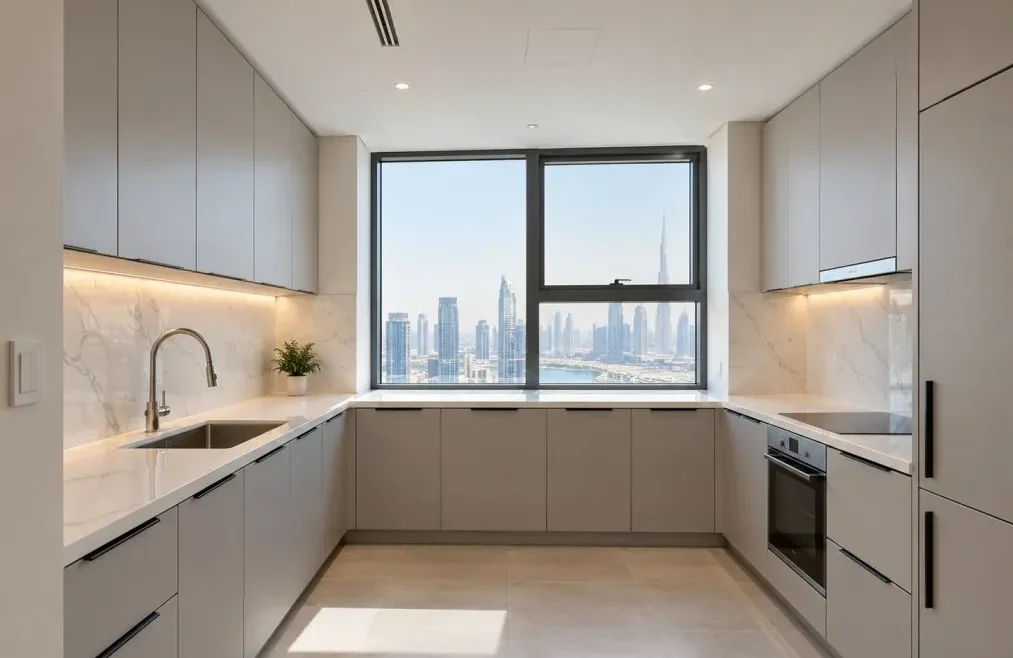
Newly fitted kitchen in a Dubai apartment with grey cabinets and a white quartz worktop

Kitchen Fit-Out Cost in Dubai: Cabinets, Worktops and Hardware Priced Out

Kitchen Fit-Out Cost in Dubai: Cabinets, Worktops and Hardware Priced Out 1013 760 admin

A kitchen fit-out cost in Dubai runs from about AED 10,000 to 17,000 for a small galley kitchen in laminate, AED 25,000 to 48,000 for a mid-range L-shaped kitchen, and AED 50,000 to 98,000 or more for a villa kitchen with an island, before appliances. Cabinets are the biggest line, followed by the worktop, then hardware, sink and tap. Below, each part is priced on its own, then added up for three typical Dubai kitchens, so you can check any quote line by line.

Key takeaways

  • Cabinets are priced per linear metre and usually take the largest share of the budget.
  • Worktops are priced per square metre, plus cut-outs, edges and fitting.
  • Hardware is where cheap kitchens fail: ask which brand of hinges and drawer runners the quote includes.
  • A like-for-like replacement usually needs only a building management permit; moving the sink or walls needs more approvals.
  • Re-facing cabinet doors and changing the worktop can cost far less than a new kitchen.

Kitchen Fit-Out Cost in Dubai at a Glance

KitchenTypical specCost before appliances
Studio or 1-bed galley (3 m run)Laminate doors, mainstream quartz, standard sink and mixerAED 9,800–17,100
2-bed L-shape (5 m base, 4 m wall, 1 tall unit)PU lacquer doors, mainstream quartz, corner unit, bin systemAED 25,200–47,600
Villa kitchen with island (8.4 m base, 4 m wall, 1.8 m tall)Wood veneer base, premium quartz, pull-out pantryAED 50,600–97,700

These totals are worked out from the price tables below, using the low and high end of each range. They include supply and installation of cabinets and worktops, but not appliances, tiling, plumbing or electrical changes, or permits.

Kitchen Cabinets Price in Dubai, Per Linear Metre

Cabinets are priced per linear metre of run: measure along the wall where the units sit. Base units cost more than wall units because they carry the worktop, drawers and sink. The door finish drives most of the difference.

Door finishBase units (AED per linear metre)Wall units (AED per linear metre)
Laminate1,500–2,2001,000–1,500
Thermofoil (PVC membrane)1,600–2,300—
Acrylic high gloss2,000–2,800—
PU lacquer2,300–3,2001,500–2,100
Aluminium frame with glass2,500–3,500—
Wood veneer2,800–4,500—
Solid wood and European brands4,500–9,000+—

Prices are supplied and installed, from M&A Technical’s October 2026 guide. Tall units, such as an oven housing or pantry, run AED 2,000–2,800 per metre in laminate and AED 2,800–3,800 in PU lacquer. Basic flat-pack laminate can start lower; one Dubai joinery lists starting prices of AED 450–600 per metre for laminate base cabinets, and quotes at that level may leave out hardware, delivery or installation.

What the cabinet box is made of matters as much as the door. In a Dubai kitchen, ask for moisture-resistant MDF or HDF, or marine plywood around the sink, because standard MDF swells when it gets wet. Check the edge banding too: a gap along an edge lets steam in.

Quartz Worktop Price in Dubai and Other Materials

Worktops are priced per square metre of finished top. A standard 60 cm deep worktop gives about 0.6 m² for every metre of run, so a 3 m galley needs roughly 1.8 m².

MaterialInstalled price (AED per m²)Good to know
Granite600–1,000Hard-wearing and heat resistant; needs sealing
Quartz, mainstream800–1,400Most common choice; keep hot pans off it
Quartz, premium European1,500–2,500Branded slabs with more colours and finishes
Porcelain or sintered stone1,500–3,000Heat and stain resistant; thin profiles

Source: Domeco, August 2026. The extras are where worktop quotes grow:

  • Undermount sink cut-out with polished edge: AED 300–800
  • Drop-in sink cut-out: AED 150–350
  • Hob cut-out: AED 150–400
  • Tap hole: AED 50–150 each
  • Mitred edge (looks thicker): AED 150–400 extra per running metre
  • A 30 mm slab costs about 30–50% more than 20 mm of the same stone

Marble is beautiful but stains and etches easily, so most fitters steer working kitchens toward quartz or granite.

Kitchen Hardware, Sinks and Taps

Hardware is a small share of the bill and a large share of the problems. Cheap hinges sag, and cheap runners stick within a year. Ask which brand the quote includes, and whether drawers are full-extension and soft-close.

ItemTypical cost (AED)
Soft-close hinge25–120+ each
Soft-close drawer runners150–600+ per drawer
Magic corner system1,200–5,000+
Pull-out pantry unit2,500–10,000+
Waste bin system400–2,500+
Bottle pull-out500–2,500+
Cutlery organiser150–800+
Standard stainless steel sink300–1,500
Granite composite sink800–4,500+
Undermount sink1,000–5,000+
Standard kitchen mixer250–1,200
Pull-out kitchen mixer800–3,500+

Source: Renovate UAE, June 2026. Many cabinet quotes include basic hinges and runners in the per-metre price; upgrades to branded soft-close systems are often extra.

How the Three Example Kitchens Add Up

Each total is the sum of the low and high ends of the ranges above.

Line itemGalley (laminate)L-shape (PU lacquer)Villa with island (veneer)
Base units3 m: 4,500–6,6005 m: 11,500–16,0008.4 m: 23,520–37,800
Wall units3 m: 3,000–4,5004 m: 6,000–8,4004 m: 6,000–8,400
Tall units—0.6 m: 1,680–2,2801.8 m: 5,040–6,840
Worktop1.8 m² quartz: 1,440–2,5203 m² quartz: 2,400–4,2006 m² premium quartz: 9,000–15,000
Sink and hob cut-outs300–750450–1,200450–1,200
Sink300–1,500800–4,5001,000–5,000
Tap250–1,200800–3,5001,500–6,000
Storage hardware—Corner unit and bin: 1,600–7,500Pantry, corner and bin: 4,100–17,500
Total (AED)9,790–17,07025,230–47,58050,610–97,740

Costs Outside the Kitchen Fit-Out Quote

A joinery quote covers cabinets and often the worktop. These usually sit outside it:

  • Appliances: a mid-range integrated appliance set costs about AED 15,000–30,000; premium brands run AED 50,000–100,000.
  • Removing the old kitchen: worktop removal and disposal is about AED 300–800; waste disposal for a full strip-out about AED 800–2,500.
  • Moving the sink or plumbing: about AED 8,000–20,000, and it changes which permits you need.
  • Electrical changes: new circuits for an oven, hob or extra appliances should be done by a DEWA-approved contractor.
  • Finishes: backsplash tiling or a glass splashback, and any wall or floor repairs found once the old units come out.

Together with the fit-out, these make up the full kitchen renovation cost in Dubai, which is why renovation guides quote higher totals than joinery quotes.

Do You Need a Permit for a Kitchen Fit-Out in Dubai?

It depends on whether the layout changes. New cabinets in the same position usually need only a building management or developer work permit or NOC. Moving the kitchen, relocating the sink or removing a wall needs an authority permit as well: Dubai Municipality for most mainland areas, or Trakhees in zones such as Palm Jumeirah, Jumeirah Islands and Al Furjan.

Developer NOC fees are typically about AED 2,000–5,000, with a refundable deposit of about AED 2,000–20,000. For the full picture, see our guide to renovation permits in Dubai.

Re-Face or Replace: The Cheaper Route

If the cabinet boxes are sound, you can keep them and change what you see. Re-facing means new doors and drawer fronts, new handles and hinges, and often a new worktop. It costs roughly AED 600–1,400 per linear metre, against AED 1,500 or more for new laminate units, and it takes two to three days on site instead of weeks.

Re-facing suits landlords refreshing a flat between tenants, and kitchens where the layout works. It is not worth it if the boxes are swollen around the sink, or if you are changing the layout.

How Long a Kitchen Fit-Out Takes

A small to medium kitchen usually takes three to six weeks from approved drawing to handover. Most of that is workshop manufacture, typically two to four weeks for made-to-measure units, while installation on site takes three to five days. Imported European kitchens take longer, often 8 to 14 weeks. Add time for building permits, and longer still if the layout changes.

What to Check in a Kitchen Fit-Out Quote

  • Measurements in linear metres for base, wall and tall units, listed separately
  • The board used for carcasses, especially under the sink
  • The door finish and edge banding
  • Hinge and runner brand, soft-close and full-extension
  • Worktop material, thickness, edge profile and every cut-out
  • Whether sink, tap, removal of the old kitchen and disposal are included
  • Who handles the building permit and any authority approvals
  • Lead time and installation days
  • Warranty on manufacture and installation

Kitchen Fit-Out With MRMO

MRMO Technical Services builds kitchens in its own carpentry workshop in Dubai, so we can fix prices and hold lead times. A carpenter visits to measure and check wall condition and service points, then you get a dimensioned drawing and a written fixed-price quote that itemises materials, hardware, finish and installation. A small to medium kitchen fit-out with MRMO typically costs AED 12,000–45,000+. See our carpentry services, or WhatsApp photos of your kitchen to +971 56 619 3696 for an indicative range the same day.

If the job is part of a bigger refresh, we also handle interior renovation, plumbing work and electrical services.

[Buttons: WhatsApp Us → https://wa.me/971566193696 · Get a Quote → /get-a-quote/]

Frequently Asked Questions

How much does a kitchen fit-out cost in Dubai?

About AED 10,000–17,000 for a small galley kitchen in laminate, AED 25,000–48,000 for a mid-range L-shaped kitchen, and AED 50,000–98,000 or more for a villa kitchen with an island. Appliances, plumbing changes and permits are extra.

How much do kitchen cabinets cost per linear metre in Dubai?

Base units run about AED 1,500–2,200 per metre in laminate, AED 2,300–3,200 in PU lacquer and AED 2,800–4,500 in wood veneer, supplied and installed. Wall units cost less, from about AED 1,000 per metre.

Which kitchen worktop is cheapest in Dubai?

Granite is usually the cheapest stone, at about AED 600–1,000 per square metre installed. Mainstream quartz runs about AED 800–1,400, and sintered stone AED 1,500–3,000, before cut-outs and edges.

Do I need a permit to replace my kitchen in Dubai?

For new cabinets in the same layout, usually only a building management or developer work permit. Moving the sink, plumbing or walls also needs Dubai Municipality or Trakhees approval, depending on the area.

How long does a kitchen fit-out take?

Usually three to six weeks from approved drawing to handover. Workshop manufacture takes two to four weeks, and installation three to five days on site.

Is re-facing kitchen cabinets cheaper than replacing them?

Yes. New doors, handles, hinges and worktop cost roughly AED 600–1,400 per linear metre and take two to three days, provided the existing cabinet boxes are dry and solid.
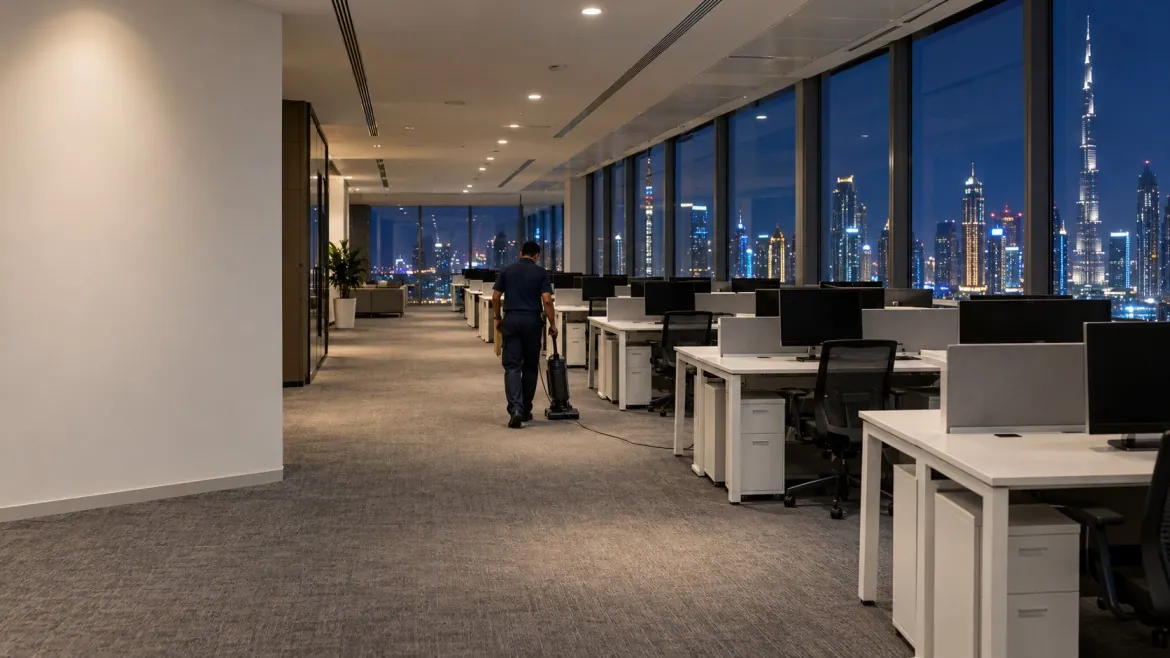
Cleaner vacuuming an empty open-plan office in Dubai at night

After-Hours Office Cleaning in Dubai: What to Ask Before You Sign a Contract

After-Hours Office Cleaning in Dubai: What to Ask Before You Sign a Contract 1170 658 admin

After-hours office cleaning in Dubai means a cleaning crew works once your team has left, in the evening, overnight or before opening, so desks, washrooms and the pantry are ready when staff arrive. It keeps vacuums out of meetings and client visits, and it suits offices, clinics and shops that cannot close during the day. The catch is that nobody from your side is there to watch, so the contract has to do the supervising. Here are the 12 questions to ask any office cleaning company in Dubai before you sign.

Key takeaways

  • Get a written scope of work that lists every task by frequency: nightly, weekly and periodic.
  • Ask whether night work is a dedicated shift or day staff on overtime; UAE law sets a higher overtime rate between 10 pm and 4 am.
  • Agree how keys, access cards and alarm codes are handed over and logged.
  • Check the trade licence, the insurance certificate and the cleaning products before the first night.
  • Compare quotes on scope and hours, not on the monthly total alone.

What After-Hours Office Cleaning in Dubai Covers

A good contract splits the work by how often it happens. Most offices need the nightly list every working day, the weekly list once a week and the periodic list a few times a year.

FrequencyTypical tasks
Every nightEmpty bins and replace liners; wipe clear desks, phones and door handles; clean and disinfect washrooms; clean the pantry sink, counters and appliance handles; vacuum carpets and mop hard floors; restock soap and paper
WeeklyDust skirting, ledges and partitions; clean internal glass and glass doors; wipe chairs and meeting-room tables; descale washroom taps and fittings
Monthly or quarterlyShampoo carpets; dust vents and light fittings at high level; deep clean the fridge and microwave; clean the inside of windows

In most towers, outside glass is cleaned by building management, not by your contractor, so leave it out of the quote unless you have a ground-floor unit.

Why Dubai Offices Clean After Hours

  • No disruption: cleaning never crosses a meeting, a call or a client visit.
  • Quieter buildings: trolleys, waste runs and wet floors are easier and safer when lifts and corridors are empty.
  • Longer opening hours: clinics, showrooms and shops trade into the evening, so cleaning fits before opening or after closing.
  • Ramadan hours: working hours are shorter during Ramadan, so ask whether the cleaning schedule moves with them.

12 Questions to Ask Before You Sign an Office Cleaning Contract

The questions fall into five groups. A contractor who answers all twelve clearly, and in writing, is usually a safe choice.

Scope and Schedule

1. What exactly is in the scope of work, and how often?

Ask for a written cleaning scope of work that lists each area (reception, open plan, meeting rooms, washrooms, pantry) and each task by frequency. “General cleaning” is not a scope. If a task is not written down, you cannot hold anyone to it.

2. What time will the crew work, and how do they get into the building?

Agree a fixed window, such as 7 pm to 10 pm or 5 am to 8 am. Many managed towers in Dubai ask contractors to register with building management or the facilities team, and some only allow entry through a service door. The contractor should handle that paperwork, not your office manager.

Staff and Supervision

3. Are the cleaners your own employees, and is night work a dedicated shift?

You want cleaners employed and sponsored by the company you sign with, not casual labour sent by a third party. Also ask whether your evening slot is covered by a night shift or by day staff on overtime. Under UAE labour law, overtime worked between 10 pm and 4 am carries a pay premium of at least 50%, against 25% for other overtime (shift workers are excepted). Overtime crews cost the contractor more and are often tired after a full day.

4. Who supervises the crew, and how will you know the job was done?

Good answers include a signed checklist for each visit, photos of the washrooms and pantry, weekly spot checks by a supervisor and a monthly walk-through with you. Agree two or three measurable standards, such as bins emptied every night and washrooms restocked, and how fast a missed item is put right.

5. What happens when a cleaner is sick or on leave?

A missed night is noticed by everyone the next morning. Ask how cover works, how quickly a replacement is sent, and whether a missed visit is credited on the invoice.

Access, Security and Confidentiality

6. How are keys, access cards and alarm codes handled?

Ask for a key and card register that names who holds each item, and agree what happens when a cleaner leaves the company. Ideally each cleaner has their own access card, so the building’s system logs every entry. Alarm codes should be personal, or changed when staff change.

7. What confidentiality rules do your cleaners follow?

An empty office is full of sensitive material. Agree that cleaners do not move papers on desks, do not touch screens or devices, and do not empty confidential shredding bins unless told to. Clinics and law firms may also want each cleaner to sign a confidentiality undertaking.

Products, Equipment and Consumables

8. Which cleaning products do you use, and are they registered?

Ask for the product list and the safety data sheets. Dubai Municipality requires cleaning products and detergents to be registered through its Montaji product system, so ask whether the products used in your office are. If staff have allergies or asthma, ask for fragrance-free products and microfibre cloths instead of aerosol sprays.

9. Who supplies toilet paper, hand soap and bin liners?

Consumables are a frequent hidden cost. Ask whether they are included in the monthly fee, supplied by you, or recharged at cost with receipts. Agree the brand and grade, so cheaper paper towels do not appear in month two.

Licence, Insurance, Price and Exit

10. Are you licensed for cleaning, and insured for damage?

Check that the company’s trade licence includes cleaning activities, and ask for a current third-party liability insurance certificate. If a cleaner spills water into a floor box or knocks a monitor off a desk, you want to know who pays before it happens.

11. How is the price built, and what changes it?

Office cleaning cost in Dubai is set in one of three ways: per hour per cleaner, per visit, or a fixed monthly fee based on floor area and frequency. As a market reference, ServiceMarket lists scheduled office cleaning from AED 25 per hour, with about AED 50 per hour for a 2-hour visit and AED 35 per hour for a 4-hour visit (October 2026). Late-night slots, materials and equipment, carpet area and the number of washrooms all move the price, so compare quotes on the same scope and hours.

12. What is the contract term, notice period and remedy if standards slip?

Ask for a short trial period, such as one month, then a rolling term with 30 days’ notice. Write in what happens after repeated missed tasks: a credit, a re-clean the next night, or the right to end the contract early.

Red Flags in an Office Cleaning Quote

  • No site visit before the price is given
  • An hourly rate with no task list
  • No insurance certificate when you ask for one
  • Nobody named as the supervisor
  • “All-inclusive” with no list of what is included
  • Cash only, or no tax invoice

How a Typical Night Visit Runs

  1. The crew signs in with building security and collects keys or cards from the agreed point.
  2. Bins and recycling go out first, so waste leaves before surfaces are wiped.
  3. Desks, phones and door handles are wiped, working from high to low.
  4. The pantry and washrooms are cleaned, disinfected and restocked.
  5. Floors are vacuumed and mopped last, working toward the exit.
  6. Lights and AC are switched off as agreed, the office is locked, the alarm is set, and the checklist and photos are sent.

After-Hours Office Cleaning With MRMO

MRMO Technical Services provides office cleaning services in Dubai as part of its 24 hour cleaning service, for offices, shops and clinics after closing, so the working day is not interrupted, and you get a written quote before any work starts. MRMO also handles AC repair, handyman work and property management, so a dripping tap, a dead light or a noisy AC unit found on a night clean can be booked with the same company. Tell us your floor area, the number of washrooms and the hours you want on WhatsApp at +971 56 619 3696, or request a quote online.

Frequently Asked Questions

How much does after-hours office cleaning in Dubai cost?

It depends on floor area, hours and frequency. Marketplace rates for scheduled office cleaning start at about AED 25 to AED 50 per cleaner per hour, and late-night slots can cost more. Ask for a fixed monthly quote based on a written scope.

Is night office cleaning more expensive than daytime cleaning?

Often, but not always. A contractor with a dedicated night shift can price close to daytime rates, while one using day staff on overtime pays a legal premium, which is higher between 10 pm and 4 am.

How often should an office be cleaned?

Washrooms, pantries, bins and busy floors need cleaning every working day. Dusting, glass and meeting rooms can be weekly, and carpets and high-level areas a few times a year.

Do night cleaners need to be supervised?

Yes, but that does not mean someone from your team staying late. Ask for a signed checklist and photos after each visit, plus regular spot checks by the contractor’s supervisor.

What should an office cleaning contract include?

A scope of work by area and frequency, the working hours, access and key rules, who supplies consumables, the price and what changes it, insurance details, service standards and the notice period.

Can office cleaning be done on weekends and public holidays in Dubai?

Usually, yes, and weekends suit periodic jobs such as carpet shampooing. Agree holiday dates in advance, check that the building admits contractors on those days, and ask whether holiday rates apply.

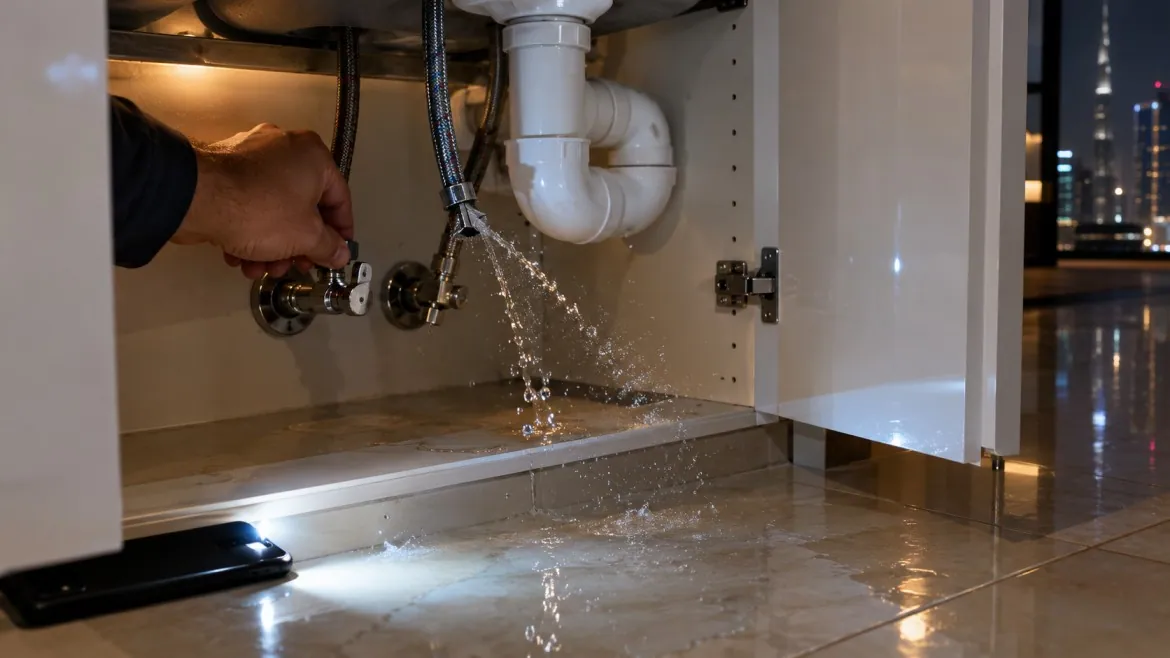
Closing the main water valve after a burst pipe at night in a Dubai apartment

Burst Pipe at Night in Dubai: What to Do Before the Plumber Arrives

Burst Pipe at Night in Dubai: What to Do Before the Plumber Arrives 1170 658 admin

A burst pipe at night in Dubai needs four things in the first ten minutes: close the main water valve, make the wet area electrically safe, call an emergency plumber, and photograph the damage. Everything else can wait for the plumber. This guide covers each step, where valves usually sit in Dubai homes, and who pays for the repair.

Your first 10 minutes

  1. Close the main water valve.
  2. Switch off power to the wet area at the distribution board (DB).
  3. Turn off the water heater.
  4. Open the cold taps to drain the remaining water.
  5. Move valuables and soak up standing water.
  6. Photograph the burst pipe and the damage.
  7. Call a 24/7 plumber, and building security if you live in a tower.

Step 1: Find and Close the Main Water Valve

Shutting off the water stops the flood. In most Dubai homes it takes under a minute, if you know where the valve is.

PropertyWhere the main valve usually isTip
ApartmentInside the unit near the kitchen, utility area or water heater; sometimes behind an access panel by the entranceIf you can’t find it, ask building security to isolate your unit at the riser
VillaNear the water meter at the boundary wall, and on the outlet line of the roof or ground tankClose both if the burst is inside the house
TownhouseNear the meter by the gate, or in the utility or garden areaCheck the tank outlet valve too
One fixtureThe small isolation valve under the sink, behind the toilet or behind the washing machineA quarter turn usually closes it

Most valves close clockwise. If the valve is stiff, use firm hand pressure; forcing an old valve with a wrench can snap it.

Step 2: Make the Area Electrically Safe

Water and electricity are the real danger in a burst pipe at night, when you are tired and the lights may be dim.

  • Water near sockets or appliances: switch off the main breaker at the DB, but only if you can reach it while standing on a dry floor.
  • The DB itself is wet, or you see sparks: don’t touch it. Leave the area and call Civil Defence on 997.
  • Water heater: switch off its breaker. An electric heater that drains while it is still powered can burn out its element.

Step 3: Limit the Water Damage

Once the water and power are off, focus on keeping the damage small.

  • Open the cold taps and flush the toilets to empty the pipes.
  • Use towels, buckets and a wet vacuum on standing water.
  • Lift rugs, electronics and furniture off the wet floor.
  • In towers, tell security and the neighbour below. Water travels through floor slabs and can soak their ceiling within an hour.
  • Don’t switch the power back on in the wet area until a technician has checked it.

Step 4: Record Everything for Your Landlord or Insurer

What you record in the first hour often decides who pays.

  • Take photos and video of the burst pipe, the water and every damaged item before you move them.
  • Note the time you found the leak and the time you shut the water off.
  • Keep receipts for any emergency costs, such as a hotel room or cleaning.
  • Ask the plumber for a written report stating the cause. Corrosion, a failed fitting and accidental damage lead to different answers on who pays.

Is It Your Pipe or DEWA’s?

Most “burst pipe Dubai” news stories are about DEWA water mains bursting under roads. Those are a different problem, with a different number to call.

DEWA is responsible for connections up to the water meter. Everything after the meter is the property owner’s responsibility.

Where the water is coming fromWho to call
A street, pavement or the pipe before your meterDEWA emergency on 991
A pipe inside your apartment or villa, after the meterAn emergency plumber
A shared riser, corridor or common area in a towerBuilding management or the facilities team
The apartment above youBuilding security, then the owner of that unit

Why Pipes Burst in Dubai (It’s Not Frost)

Dubai pipes don’t freeze, so bursts come from pressure, age and fittings. Most of them give warning signs first.

CauseWarning signs to watch for
Failed flexible hose under a sink or toiletRust spots or bulging in the braided cover
High pressure from a booster pumpPipes bang when a tap closes (water hammer)
Corroded metal pipes in older buildingsBrown water, damp patches on walls
Poor joints from earlier renovation workDrips at fittings, stains on ceilings below
Water heater relief valve failureConstant dripping from the heater’s overflow pipe
Sun-damaged plastic pipes on villa roofsFaded, brittle or cracked pipe surfaces

What the Plumber Does When They Arrive

A good emergency plumber does more than patch the split. Expect these steps:

  1. Confirm the supply is isolated, and isolate it further if needed.
  2. Find the exact failure point and its cause.
  3. Make a temporary repair (a clamp or coupler) or a permanent one, depending on parts and access.
  4. Restore water and pressure-test the repaired line.
  5. Check walls, ceilings and floors for trapped moisture.
  6. Give you a written report on the cause, for your landlord or insurer.

Who Pays for a Burst Pipe in Dubai?

The answer depends on where the pipe failed and why. Your tenancy contract and insurance policy have the final word.

SituationUsually responsible
Pipe before the meter, or in the streetDEWA
Pipe inside a rented unit, failed through age or wearLandlord
Damage caused by tenant misuseTenant
Shared riser or common-area pipeBuilding owner or owners’ association
Leak coming from the unit aboveOwner of that unit, often through their insurance

If a landlord and tenant can’t agree, rent disputes in Dubai go to the Rental Dispute Settlement Centre. This guide is general information, not legal advice.

How Much Does an Emergency Burst Pipe Repair Cost in Dubai?

Prices depend on the time of day, access and parts. MRMO quotes in writing before starting any work.

JobStarting price
After-hours emergency call-out200 AED
Flexible hose replacement100 AED
Isolation valve replacement100 AED
Pipe section repair150 AED
Opening and refinishing a wall or ceiling250 AED

How to Prevent a Burst Pipe

Most of these checks take minutes and can save a night like this.

  • Find and label your main water valve today.
  • Replace braided flexible hoses that show rust or bulging.
  • Ask a plumber to check booster pump pressure if your pipes bang.
  • Twice a year, turn off every tap and check the water meter. DEWA’s advice: if the meter still moves, there is a leak.
  • Close the main valve when you travel for more than a few days.
  • Book a yearly plumbing check in older buildings.

Frequently Asked Questions

Should I turn off the main water valve if a pipe bursts?

Yes. Closing the main valve is the first step for any burst pipe, because it stops the water feeding the leak. Then switch off power to the wet area and call a plumber.

Who do I call for a burst water pipe on the street in Dubai?

Call DEWA on 991. DEWA is responsible for water pipes and connections up to your meter, including mains under roads and pavements.

Is a burst pipe the landlord’s responsibility in Dubai?

Usually, if the pipe failed through age or normal wear in a rented property. If the tenant caused the damage, the tenant may pay. The tenancy contract decides, and disputes go to the Rental Dispute Settlement Centre.

Does home insurance cover a burst pipe in Dubai?

Many home insurance policies cover sudden, accidental water damage but exclude slow leaks and poor maintenance. Check your policy wording, and report the claim to your insurer as soon as possible.

Can I fix a burst pipe myself?

You can slow a small split with pipe repair tape or a clamp, but only as a stopgap. A permanent repair needs the damaged section replaced and the line pressure-tested by a plumber.

How fast can an emergency plumber reach me at night in Dubai?

MRMO Technical Services aims to reach most of Dubai within 90 minutes for night-time emergencies . Close the main valve while you wait, so the damage stops growing.

Burst pipe right now? Close the main valve, then call or WhatsApp MRMO Technical Services for a 24/7 emergency plumber.

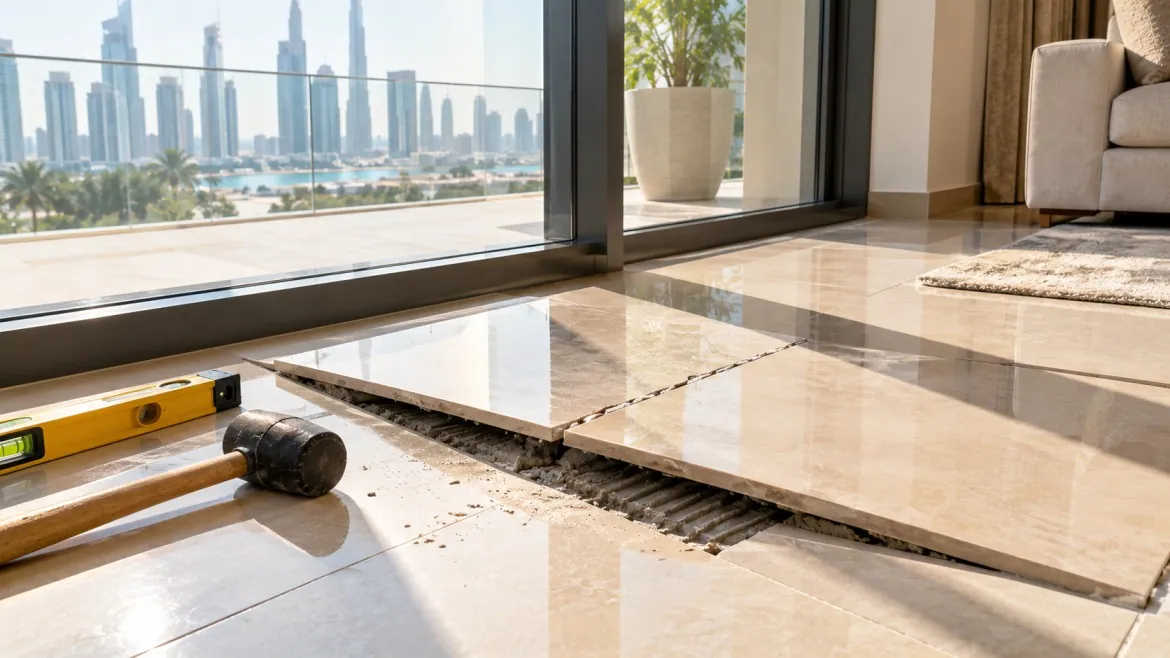
Large porcelain floor tiles lifting near a sunlit glass door in a Dubai apartment

Why Tiles Pop Up, Crack or Sound Hollow in Dubai Homes (and What Repairs Cost)

Why Tiles Pop Up, Crack or Sound Hollow in Dubai Homes (and What Repairs Cost) 1170 658 admin

Tiles popping up in a Dubai home are almost always caused by one of three things: no movement joints to absorb heat expansion, too little adhesive under each tile, or water getting underneath. A hollow sound when you tap a tile is the early warning; lifting, cracking or a “tent” of raised tiles is the late stage. Fixing a few loose tiles usually costs a few hundred dirhams; relaying a section runs from about AED 100 per square metre plus new tiles.

The Six Most Common Causes

Most failing floors have more than one of these at work.

  1. No movement joints. Tiles expand and contract with temperature. In Dubai, floors near glass doors and terraces swing between strong sun and air-conditioned cool every day. Without flexible joints, the pressure builds until tiles lift or crack. A UAE tile supplier recommends joints every 6–8 m indoors and every 3–4 m outdoors, plus at doorways and around the room’s edge (Al Shabib Trading).
  2. Too little adhesive. Fixing tiles on a few dabs of adhesive instead of a full bed leaves air pockets. Those tiles sound hollow from day one and crack when furniture or foot traffic loads the unsupported corners.
  3. Tiling over a screed that was not ready. A sand-and-cement screed needs time to cure and dry. Tiling over it too soon, or over a cracked or uneven base, passes every movement straight to the tiles.
  4. Water underneath. A failed shower waterproofing membrane, a leaking pipe under the floor or a dripping AC drain line can saturate the bed. The adhesive weakens and the tiles loosen, often with dark grout or a damp smell first.
  5. Large tiles on an uneven floor. 60×120 cm and larger tiles need a very flat base. On an uneven screed they rock, sound hollow at the corners and chip at the edges.
  6. Impact. A dropped pan or tool can crack a single tile, especially one that was already hollow underneath.

How to Check Your Own Floor

You can find most problems in ten minutes with a coin or the handle of a screwdriver.

  • Tap test. Tap across each tile. A solid “click” means it is well bonded; a hollow, drummy sound means there is air underneath.
  • Look at the grout. Cracked or crumbling grout in a straight line often follows a crack in the screed below.
  • Check the edges. Lift the skirting silicone or look at the gap at the wall. If tiles are tight against the wall with no gap, there is nowhere for expansion to go.
  • Look for a pattern. One cracked tile is usually impact. A row of tiles lifting across a room points to missing movement joints. Loose tiles around a shower or under a sink point to water.

A few hollow tiles are common and not urgent. Hollow tiles spreading across a room, or tiles that move under your foot, should be fixed before they crack and leave sharp edges.

What Tile Repairs Cost in Dubai

These are typical 2026 prices before VAT. Repair prices are market estimates for Dubai; relaying costs combine published labour and material rates.

RepairTypical cost (AED, excl. VAT)Notes
Replace 1–3 cracked tiles (spare tiles available)150–400 per visitMatching tiles are the main challenge
Re-fix loose or hollow tiles60–120 per tileLift, clean, re-bed and regrout
Regrout a bathroom400–900Depends on size and grout type
Add movement joints or redo perimeter silicone15–30 per linear metreOften fixes recurring “tenting”
Relay a section: remove, re-screed if needed, refix100–200 per m², plus new tilesLabour about AED 40–85/m²; removal AED 15–30/m²
New porcelain tiles (supply only)40–180 per m²Standard 60×60 cm at the lower end

Labour rates of AED 40–85 per m² for ceramic and porcelain come from published Dubai tile fixing rates (Tile Fixing Rates in Dubai). Removal and tile supply costs come from a UAE tile retailer (Tile Mountain). For a fixed price on your own floor, see our tile work in Dubai page.

Repair a Few Tiles or Relay the Floor?

Repair is the right call when the problem is limited: a handful of hollow or cracked tiles, no pattern, and spare tiles from the same batch.

Relaying is better when:

  • hollow tiles are spread across most of the room
  • tiles keep lifting after earlier repairs, which usually means missing movement joints or a failed screed
  • water has got under a bathroom floor, since the waterproofing has to be redone before new tiles go down
  • you cannot find matching tiles and a patch would look obviously different

If you are already planning a renovation, relay the floor as part of it rather than paying for repairs first.

Stop Water Before You Fix the Tiles

Re-fixing tiles over a wet bed is wasted money; they will loosen again. If loose tiles are near a shower, bath, kitchen sink or an indoor AC unit, find the water first.

  • Around showers and baths, the waterproofing membrane under the tiles may have failed. A plumber can pressure-test the pipes and check the waste connections; see our plumbing work service.
  • Near an indoor AC unit, a blocked condensate line can drip into the wall and floor. Our guide to why your AC is leaking water covers the fix.

New Home? Check the Tiles at Handover

Hollow tiles are one of the most common snags in new Dubai apartments and villas. Check them before handover, while the developer is still responsible. A building inspection tap-tests every floor and records the hollow tiles room by room, so the developer can fix them under warranty.

How to Prevent Tiles Popping Up Again

  • Insist on full adhesive coverage, back-buttering large tiles so there are no air pockets.
  • Leave movement joints at the perimeter, doorways and across large or sunlit floors, filled with flexible sealant instead of grout.
  • Let the screed cure before tiling.
  • Waterproof every wet area before tiling, and test it.
  • Keep 5–10% spare tiles from the original batch, labelled, so future repairs match.

Frequently Asked Questions

Why are my floor tiles popping up?

Usually because there are no movement joints to absorb heat expansion, the tiles were fixed with too little adhesive, or water has got underneath. In Dubai, sunlit floors next to air-conditioned rooms are especially prone to it.

Are hollow-sounding tiles a problem?

A few are common and not urgent. Many hollow tiles, or hollow tiles that are spreading or moving underfoot, mean the bond is failing and the tiles are likely to crack or lift.

How much does it cost to fix loose tiles in Dubai?

Re-fixing a loose or hollow tile typically costs AED 60–120 per tile before VAT. Replacing one to three cracked tiles usually costs AED 150–400 per visit, provided matching spare tiles are available.

Can a single cracked tile be replaced?

Yes. A technician cuts out the grout, lifts the cracked tile, cleans the bed and fixes a new tile in its place. The hard part is finding a matching tile, which is why it pays to keep spares.

What is tile tenting?

Tenting is when tiles push against each other and lift into a raised ridge, sometimes with a loud crack. It is usually caused by thermal expansion with no movement joints to absorb it.

How long does tile repair take?

Replacing a few tiles takes a few hours, though the grout needs about a day before heavy use. Relaying a room usually takes two to four days, longer if the screed needs replacing.

Book a Tile Inspection with MRMO

MRMO Technical Services repairs and relays tiles across Dubai, with in-house tilers and plumbers to find and fix the cause, not just the cracked tile. We tap-test the floor, show you what we find and give you a fixed price before any work starts. Book on our tile work in Dubai page, call +971 56 619 3696, or message us on WhatsApp.

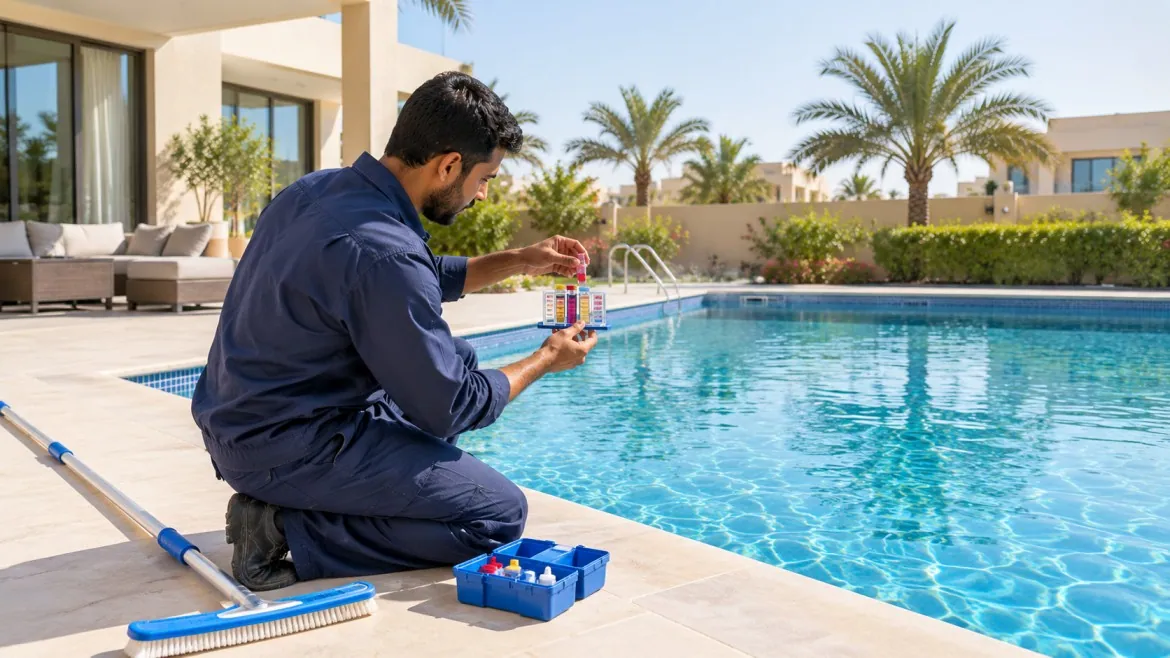
Technician testing pool water beside a villa swimming pool in Dubai

Pool Maintenance Cost in Dubai: What a Villa Pool Costs to Run in 2026

Pool Maintenance Cost in Dubai: What a Villa Pool Costs to Run in 2026 1170 658 admin

The pool maintenance cost in Dubai for a typical villa pool is AED 350–600 a month for twice-weekly service visits, before VAT. Add chemicals and electricity and the full running cost is usually AED 800–1,500 a month. Pool size, how often the technician visits, whether chemicals are included, and whether you run a pool chiller in summer decide where you land.

Pool Maintenance Prices in Dubai

These are typical 2026 prices for a private villa pool in Dubai, before VAT.

ItemTypical cost (AED)Notes
Service visits, once a week300–450 a monthCleaning, testing, backwash; chemicals usually extra
Service visits, twice a week350–600 a monthThe usual choice from May to September
Chemicals200–500 a monthHigher in summer, when chlorine burns off faster
Electricity for pump and chiller300–800 a monthChiller adds most of this in summer
Annual maintenance contractFrom 4,000 a yearFixed visits; check what repairs are included
Green pool recovery (one-off)800–2,500Shock treatment, filter clean, extra visits
Filter sand or media change600–1,500Every 3–5 years for sand filters
Pump replacement2,000–5,000Depends on pump size and brand
Leak detection800–2,000Pressure testing and dye tests
Pool chiller supply and installation15,000–20,000One-off; keeps summer water swimmable

Service, chemical and electricity ranges come from published Dubai figures (Real Estate Club Dubai, ServiceMarket). Repair prices are typical market rates and vary with the job. To get a fixed price for your own pool, see our swimming pool maintenance page.

What a Service Visit Should Include

A proper visit is more than skimming leaves. For the monthly fee, expect:

  • Skimming and vacuuming the floor, steps and waterline.
  • Brushing walls and tiles, which stops algae taking hold in corners and on steps.
  • Emptying skimmer and pump baskets.
  • Testing the water and adjusting chemicals on the spot.
  • Backwashing the filter when the pressure gauge shows it is loaded.
  • A visual check of the pump, filter and chiller, with any faults reported.
  • A visit report, ideally with the test readings, so you can see the trend over time.

Ask whether chemicals are included in the fee. A low monthly price with chemicals charged separately can cost more than an all-inclusive one.

The Water Readings Your Technician Should Record

Dubai heat and high evaporation push water chemistry out of balance faster than in cooler climates. These are the standard target ranges for a chlorinated residential pool:

ReadingTarget rangeWhy it matters in Dubai
Free chlorine1–3 ppmBurns off fast in summer sun; needs daily dosing or a chlorinator
pH7.2–7.6Outside this range chlorine stops working and eyes sting
Total alkalinity80–120 ppmKeeps pH stable between visits
Calcium hardness200–400 ppmRises as water evaporates and is topped up
Cyanuric acid (stabiliser)30–50 ppmProtects chlorine from UV; too much makes chlorine sluggish

If your technician cannot show you these numbers, ask for them. Readings that drift visit after visit are the early warning of algae or scale.

Why Pools Cost More to Run in a Dubai Summer

From May to September, pool costs climb for three reasons.

  • Chlorine burns off. Strong sun and water temperatures above 30°C break chlorine down quickly, so the pool needs more of it, more often.
  • Evaporation. Pools lose water every day in summer. Top-up water adds minerals, which pushes calcium hardness up and eventually means partly draining and refilling.
  • The chiller. Without one, villa pool water can get too warm to be refreshing in July and August. A chiller fixes that but adds to the electricity bill every month it runs.

Most owners switch from weekly to twice-weekly visits for the summer, then drop back in October.

Contract or Pay Per Visit?

Pay per visit suits owners who do some of the work themselves, or who use the pool only in winter. A contract suits most villa owners, because it fixes the monthly cost and makes one company responsible for the water.

Before you sign, check:

  1. How many visits a week, and whether that changes in summer.
  2. Whether chemicals are included, and which ones.
  3. What happens if the pool turns green between visits. A good contract covers recovery at no extra labour charge.
  4. Whether repairs are covered or quoted separately, and the call-out time for a pump failure.
  5. What the visit report shows. Test readings and photos are the minimum.

If you own several properties, pool care can sit inside a wider property management contract, so one team handles the pool, AC and plumbing.

Repairs That Push the Bill Up

Most unexpected pool costs come from a handful of problems.

  • Pump failure. Pumps run for hours every day in Dubai’s heat. A noisy, hot or tripping pump should be checked before it seizes. If the pump trips the breaker, have a qualified electrician check the supply as well as the pump.
  • Leaks. If you are topping up more than the normal summer evaporation, or tiles are lifting, get a leak test. A small leak left alone can undermine the pool shell.
  • Loose or cracked tiles. Heat and chemical imbalance loosen tiles at the waterline. Fixing a few early costs far less than a full retile; see our tiling work service.
  • Green water. Usually the result of missed visits, a broken chlorinator or a dead pump. Recovery costs more than the visits it replaced.

How to Keep Pool Maintenance Costs Down

  • Use a pool cover when the pool is not in use. It cuts evaporation, chemical loss and debris.
  • Run the pump at night where possible, when electricity demand is lower and the water is cooler.
  • Keep chemicals in balance between visits. A cheap test kit lets you catch a problem the day it starts.
  • Trim trees and hedges that drop leaves into the pool.
  • Service the chiller before summer, not after it fails in July.

Frequently Asked Questions

How much does pool maintenance cost in Dubai?

Twice-weekly service visits for a villa pool usually cost AED 350–600 a month before VAT. With chemicals and electricity, the full running cost is typically AED 800–1,500 a month, and higher in summer if you run a chiller.

How often should a pool be serviced in Dubai?

Twice a week from May to September and once a week for the rest of the year suits most villa pools. Pools that are used heavily or sit under trees may need more.

Are chemicals included in pool maintenance contracts?

Sometimes. Some companies include standard chemicals in the monthly fee; others charge them separately at around AED 200–500 a month. Check before you compare quotes.

How much does a pool chiller cost in Dubai?

Supplying and installing a pool chiller typically costs AED 15,000–20,000, plus higher electricity bills in the months it runs.

Why does my pool turn green in summer?

Heat and sun break down chlorine quickly. If dosing, filtration or visits fall behind for even a few days, algae grows. A shock treatment and filter clean usually clears it.

What should the pH of a pool be?

Between 7.2 and 7.6. Outside that range, chlorine works less well and swimmers notice stinging eyes and dry skin.

Get a Fixed Pool Maintenance Quote from MRMO

MRMO Technical Services services villa and community pools across Dubai, with in-house technicians for cleaning, chemical balancing and equipment repairs. We inspect the pool, test the water and give you a fixed monthly price before we start. Book on our swimming pool maintenance in Dubai page, call +971 56 619 3696, or message us on WhatsApp.

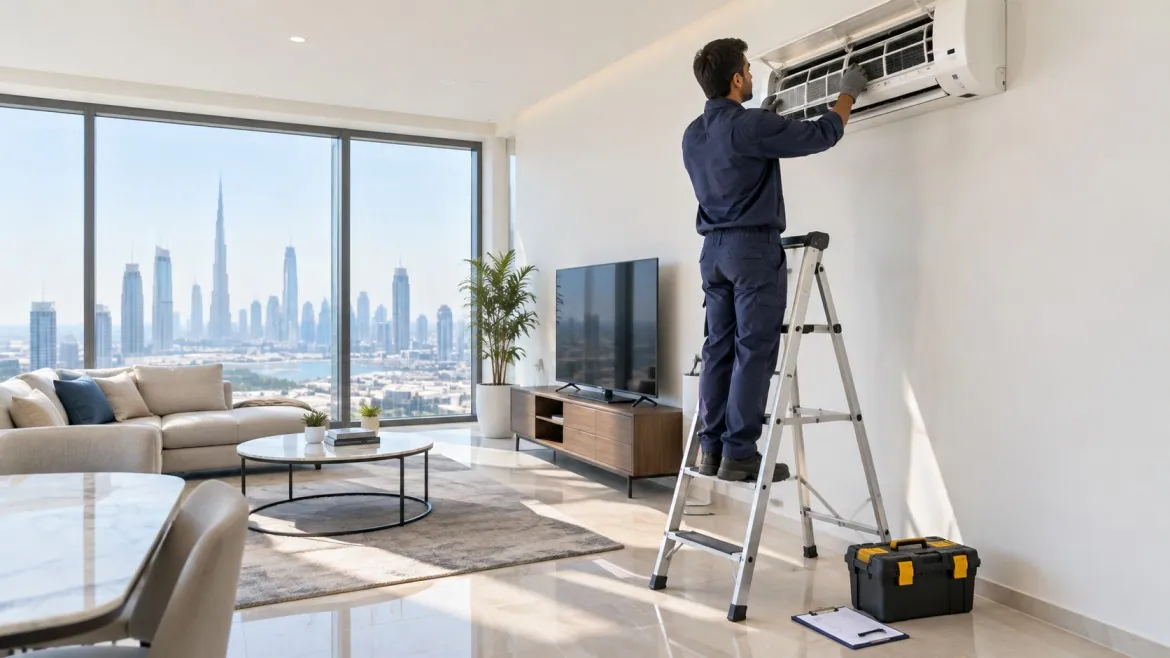
Technician servicing a wall-mounted AC unit in an empty Dubai apartment between tenants

Property Maintenance Checklist for Dubai Landlords: Every Season and Every Tenant Change

Property Maintenance Checklist for Dubai Landlords: Every Season and Every Tenant Change 1170 658 admin

A property maintenance checklist for Dubai landlords comes down to three moments: before summer, when AC systems take the strain; after summer, before the winter rains; and between tenants, when you document the unit’s condition. Water tanks need cleaning twice a year, ACs need servicing at least once before summer, and every handover needs a dated photo report. The calendar below sets out what to do and when for apartments and villas.

Year-Round Maintenance Calendar for Dubai Rentals

Use this as the base property maintenance checklist for a rented apartment or villa in Dubai. Tasks marked “Building” are normally handled by the building’s facilities management in an apartment block, but it is worth confirming they happen.

TaskWhenApartmentVilla
AC service: filters, coils, drain line, gas checkMarch–April, before summerYesYes
AC filter cleanEvery 1–3 monthsTenant, usuallyTenant, usually
AC duct cleaningOnce a yearYesYes
Water tank cleaning and disinfectionTwice a yearBuildingYes
Roof and balcony drain clearingOctober–November, before the rainsBalcony onlyYes
Irrigation check and timer resetOctober and March—Yes
Water heater check and descalingOnce a yearYesYes
Bathroom and kitchen sealant, groutOnce a yearYesYes
Electrical board and RCD testOnce a yearYesYes
Smoke detector testEvery six monthsYesYes
Pest controlEvery 3–6 monthsYesYes
Roof waterproofing and external paint inspectionAfter summer, once a yearBuildingYes

Dubai Municipality guidance is that water tanks should be cleaned and disinfected at least twice a year by an approved company, and the landlord is accountable for it (Gulf News). Keep the certificate each time; tenants are entitled to ask for it.

Before Summer: March to May

Summer is when Dubai rentals fail, and AC is almost always the first call. A tenant without cooling in August will chase you hard, and parts and technicians are in short supply in peak season.

  • Book an AC service for every unit in March or April: clean filters and coils, flush the condensate drain line, and check refrigerant pressure.
  • Test the thermostat in every room and replace any with failing displays or batteries.
  • Check that external units are shaded where possible and not blocked by stored items.
  • For villas, check the irrigation system and reset the timer for summer, and inspect the pool pump and filter.
  • Walk the roof or terrace and look for cracked waterproofing before it bakes for four months.

After Summer: October and November

After summer is the time to repair what the heat damaged and prepare for the few heavy rains Dubai gets each winter.

  • Clear roof drains, balcony drains and external gullies. Blocked roof drains are the most common cause of water coming through ceilings during winter storms. See our drainage cleaning service.
  • Check silicone around windows and external doors; heat shrinks it and lets water and dust in.
  • Inspect external paint and boundary walls on villas for cracks and flaking.
  • Reset the irrigation system for cooler weather; summer timer settings waste water from October onward.
  • Arrange the second water tank cleaning of the year if the first was done in spring.

Between Tenants: Move-Out to Move-In Checklist

The weeks between tenants are your best chance to fix problems without disturbing anyone, and your best chance to record evidence that protects the deposit and your next tenancy.

  1. Do the move-out inspection with the outgoing tenant present. Compare the unit against the check-in report, room by room, with dated photos.
  2. List the snags. Separate normal wear (faded paint, worn grout) from damage the tenant caused (broken fittings, holes in walls). This list decides what comes out of the deposit.
  3. Service the AC and check the water heater, even if neither has failed. A new tenant’s first complaint is usually one of the two.
  4. Repaint, regrout and reseal as needed. Fresh sealant in wet areas prevents the leak complaints that follow a few months later.
  5. Change the locks or recode the access. A handyman service can swap cylinders in under an hour.
  6. Deep clean the unit, including AC grilles, kitchen exhaust and balcony. Our cleaning services cover move-out cleans.
  7. Do the check-in report for the new tenant. Photograph every room, meter readings and any existing marks, and have the tenant sign it.

For a new or newly handed-over property, a full building inspection before the first tenant moves in catches developer defects while they are still under warranty.

Who Pays for Repairs: Landlord or Tenant?

In Dubai, Law No. 26 of 2007 sets the baseline. Article 16 makes the landlord responsible for maintenance and for repairing defects that affect the tenant’s use of the property. Article 19 requires the tenant to look after the property the way an ordinary person looks after their own home (Gulf News).

In practice, landlords cover structural issues and major systems such as AC units, wiring and plumbing. Tenants cover routine upkeep such as AC filter cleaning and light bulbs, plus any damage they cause. Many tenancy contracts add a threshold, for example tenants paying for minor repairs under a set amount. Check your own contract, since its wording decides most disputes.

Keeping Records If You Live Overseas

Many Dubai landlords live abroad, and the records you keep are what protect you in a dispute. For every job, keep:

  • the date, the problem reported and who reported it
  • before-and-after photos
  • the invoice and any warranty on parts
  • certificates for water tank cleaning and pest control

If a disagreement reaches the Rental Disputes Settlement Centre, check-in and check-out reports, technician assessments and dated notices are what it looks at. A maintenance provider that sends photo reports after every visit builds that file for you.

Maintenance Contract or Pay Per Job?

Paying per job suits a single apartment with a careful tenant and a new building. A maintenance contract suits villas, older units and owners who live overseas, because preventive visits are scheduled and urgent repairs are covered without a new quote each time.

Check how a contract handles mark-ups. Full-service property managers in Dubai often add 10–20% to contractor invoices for coordinating repairs, on top of their management fee (Real Estate Club Dubai). A maintenance contract with the contractor directly avoids that layer, though you still need a RERA-registered agent for leasing, Ejari and rent collection.

Frequently Asked Questions

What maintenance is a landlord responsible for in Dubai?

Under Law No. 26 of 2007, the landlord is responsible for maintaining the property and repairing defects that affect the tenant’s use of it, such as structural issues and major systems like AC, wiring and plumbing. The tenancy contract can add detail, such as a threshold for minor repairs.

How often should water tanks be cleaned in Dubai?

At least twice a year, by a Dubai Municipality-approved company, with the water tested afterwards. The landlord or building owner is responsible, and tenants can ask to see the cleaning records.

When should I service the AC in a rented property?

Before summer, ideally in March or April. That gives time to fix faults before peak demand, when technicians and parts are hardest to get.

What should a landlord check between tenants?

Do a move-out inspection with dated photos, list snags, service the AC and water heater, repaint and reseal where needed, change the locks, deep clean, and complete a signed check-in report for the new tenant.

Is an annual maintenance contract worth it for a single apartment?

It depends on the unit. For a new apartment with a careful tenant, paying per job is often cheaper. For older units, villas or landlords living overseas, a contract usually saves money and time through scheduled preventive visits.

Can a maintenance company collect rent or register Ejari for me?

Only if it is a RERA-registered property management company. A maintenance-led provider handles repairs and preventive work and works alongside your leasing agent, who handles tenants, Ejari and rent.

Book a Pre-Winter Property Check with MRMO

MRMO Technical Services keeps Dubai rentals in working order with in-house AC, plumbing and electrical teams, photo reports after every visit and maintenance contracts for single units and portfolios. Book a check-up or ask about a contract on our property management services page, call +971 56 619 3696, or message us on WhatsApp.

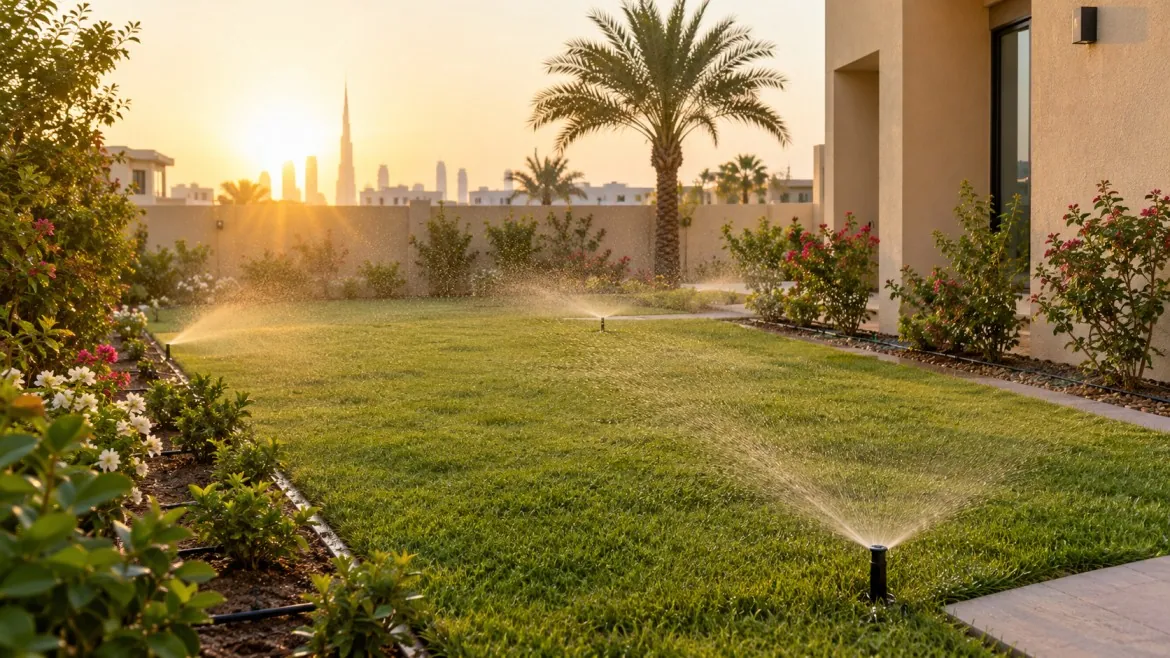
Pop-up sprinklers watering a villa lawn in Dubai at sunrise

Garden Watering Schedule for Dubai: How Long to Run Your Irrigation Each Month

Garden Watering Schedule for Dubai: How Long to Run Your Irrigation Each Month 1170 658 admin

A good garden watering schedule in Dubai runs lawn sprinklers twice a day for 5–7 minutes in summer and every other day in winter, with drip lines on beds running 20–40 minutes depending on the month. Always water before 8 am or after 7 pm. The table below gives timer settings for each season, then explains how to adjust them for your plants, your soil and your water bill.

Dubai Irrigation Timer Settings by Season

These settings suit an established villa garden on sandy soil with pop-up spray heads on the lawn and drip lines in the beds. New planting needs more; shaded gardens need less.

SeasonLawn (pop-up spray heads)Shrub and flower beds (drip)Trees (bubblers or drip rings)
Winter, Dec–FebEvery other day, 5 min2–3 times a week, 15–20 minOnce a week, 30–45 min
Spring, Mar–AprDaily, 5–7 min, morningEvery other day, 20–30 minTwice a week, 30–45 min
Summer, May–SepTwice daily, 5–7 min, early morning and eveningDaily, 30–40 min2–3 times a week, 45–60 min
Autumn, Oct–NovDaily, 5–7 min, morningEvery other day, 20–30 minTwice a week, 30–45 min

If your lawn uses rotor heads instead of spray heads, run them about three times longer, because rotors put down water much more slowly. Lawn timings follow common Dubai practice of twice-daily short cycles in summer and alternate days in winter (ServiceMarket).

The Best Time to Water a Garden in Dubai

Water before 8 am or after 7 pm. Midday watering in a Dubai summer can lose 30–50% of the water to evaporation before it reaches the roots (Acacia Garden Centre).

Early morning is the best slot for lawns, because the grass dries during the day and fungus has less chance to take hold. Evening is fine for drip lines, since they wet the soil rather than the leaves. Set the controller so zones run one after another, not at once, or the water pressure will drop and the far heads will under-water.

How to Adjust the Schedule for Your Garden

The table is a starting point for any garden watering schedule in Dubai. Four things change it.

  • New planting. Anything planted in the last four weeks needs daily water, even in winter, until its roots reach the surrounding soil. October and November are Dubai’s main planting months, so check your timer after any new planting.
  • Soil type. Dubai’s sandy soil drains fast. Short, frequent cycles keep roots supplied; one long run sends water straight past them. If water pools or runs off, split one long run into two shorter ones.
  • Shade and exposure. West-facing beds and walls that reflect heat dry out fastest. A bed under a pergola or outdoor shade can often drop a full day from its schedule.
  • Plant type. Lawns need the most water per square metre. Established native and desert-adapted shrubs need far less, and many trees prefer a deep soak a few times a week to daily shallow watering.

How to Tell If You Are Over- or Under-Watering

Your plants show the problem before your bill does.

SignLikely causeWhat to change
Yellowing lawn with soft, spongy patchesOver-wateringCut run time by a third; water mornings only
Mushrooms or green algae on soilOver-wateringReduce frequency; check for a stuck valve
Grey-blue lawn patches that stay flat when walked onUnder-wateringAdd a minute per cycle; check head coverage
Leaves crisping at the edges in one bed onlyThat zone is under-watered or a dripper is blockedFlush the drip line; check emitters
Puddles near one head or a constantly wet patchBroken head or a leak in the lineShut the zone and repair before running again

Push a screwdriver into the soil an hour after watering. It should slide in easily to about 15 cm. If it stops sooner, the water is not reaching the roots.

What Over-Watering Costs on Your DEWA Bill

If your garden runs on DEWA water, every extra minute shows up on your bill. DEWA’s residential water rates start at about AED 7.70 per cubic metre and rise to AED 10.12 in the top band, plus a fuel surcharge of AED 1.10 per cubic metre (Property Finder).

As a worked example, a villa with a 100 m² lawn and a few planted beds might use around 28 cubic metres a month on irrigation in summer. That is roughly AED 250–300 a month before VAT, on top of the household’s own water use, and it often pushes the whole bill into a higher band. A schedule that runs 30% longer than the garden needs wastes about AED 60–70 a month at those rates.

Some villa communities supply treated water for garden irrigation instead of DEWA water, billed differently (Gulf News, 2018). If you are on treated water, the schedule still matters for plant health, and the extra minerals mean drip filters need flushing more often.

Setting Up a Smart Irrigation Controller

A smart controller connects to Wi-Fi and adjusts run times to the weather. In Dubai that mostly means cutting back automatically during cooler weeks and skipping a cycle after rare rain, which a basic timer cannot do.

When you set one up:

  1. Name each zone by what it waters (lawn front, beds west, trees) so seasonal changes take seconds.
  2. Enter the head type for each zone (spray, rotor or drip), so the controller calculates run times correctly.
  3. Use the seasonal adjust setting instead of rewriting every program each month. Set summer as 100% and winter at about 40–50%.
  4. Turn on cycle-and-soak for lawns on sloping ground, so water soaks in between short bursts.

MRMO supplies and wires smart controllers as part of our irrigation system installation service.

Before You Travel for the Summer

Many Dubai families leave for weeks in July and August, the hottest part of the year. Before you go:

  • Run every zone and walk the garden to check each head and dripper is working.
  • Flush the drip lines and clean the filter, so a blockage does not starve a bed while you are away.
  • Add 2–5 cm of mulch to beds to slow evaporation.
  • Ask a neighbour or your gardener to check the garden once a week, or have a maintenance contract in place.

Landlords with vacant villas can include garden checks in a property management service, so a broken pipe does not run unnoticed for a month.

Frequently Asked Questions

How often should I water my garden in Dubai?

In summer, water lawns twice daily and drip beds daily. In winter, water lawns every other day and drip beds two or three times a week. New planting needs daily watering for the first four weeks in any season.

How long should I run my sprinklers in Dubai?

Pop-up spray heads need about 5–7 minutes per cycle. Rotor heads need roughly three times longer, around 15–20 minutes, because they apply water more slowly.

What is the best time to water plants in Dubai?

Before 8 am or after 7 pm. Early morning is best for lawns, because the grass dries during the day. Midday watering wastes much of the water to evaporation.

How long should drip irrigation run in Dubai?

Drip lines on shrub and flower beds usually run 30–40 minutes a day in summer and 15–20 minutes two or three times a week in winter. Trees on drip rings or bubblers need a longer, deeper soak less often.

Why is my lawn turning yellow even though I water every day?

Daily yellowing with soft, spongy ground usually means over-watering, not under-watering. Cut each cycle by a third, water only in the morning, and check that no valve is stuck open.

Should I water less in winter?

Yes. From December to February, most Dubai gardens need roughly 40–50% of their summer water. Lower the controller’s seasonal adjust instead of deleting your summer programs.

Get Your Irrigation Checked Before Winter Planting

MRMO Technical Services designs, installs and repairs garden irrigation across Dubai, with in-house plumbers and DEWA-approved electricians for pumps and controllers. We can check every zone, fix leaks and set your timer for the season in one visit. Book on our irrigation Dubai page, call +971 56 619 3696, or message us on WhatsApp.

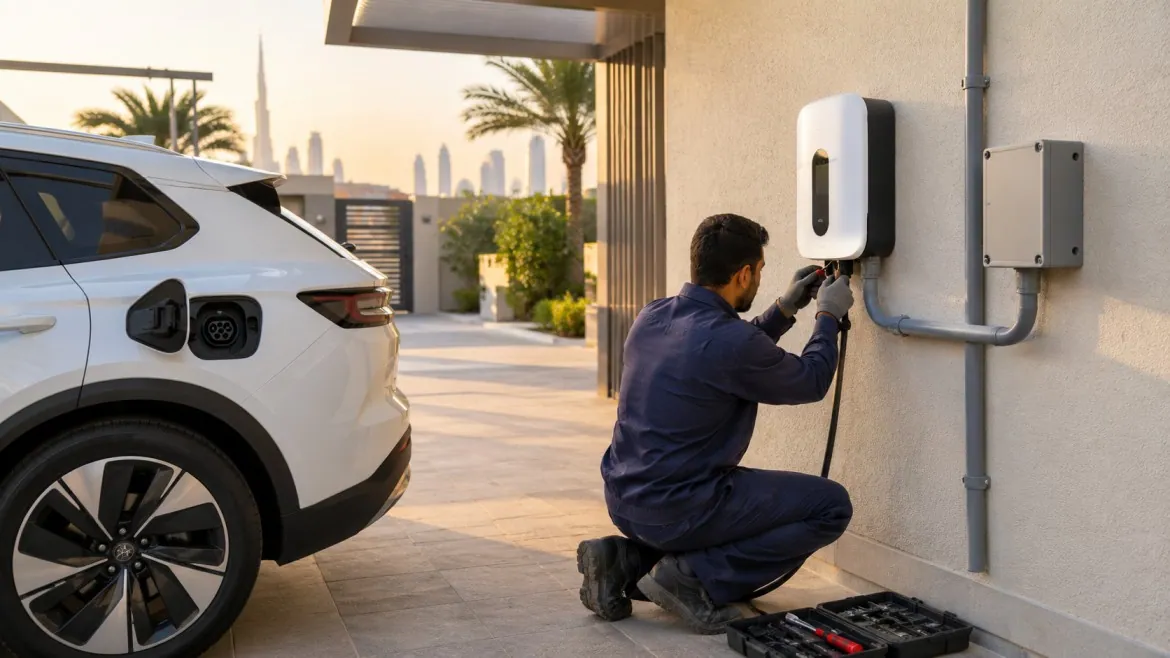
Electrician mounting a wall-mounted EV charger in a Dubai villa car porch

EV Charger Installation Cost in Dubai: What You’ll Pay in 2026

EV Charger Installation Cost in Dubai: What You’ll Pay in 2026 1170 658 admin

The EV charger installation cost in Dubai is usually AED 3,500–6,000 for a 7.4 kW wallbox in a villa, charger and installation included, before VAT. Apartments cost more, typically AED 5,000–10,000, because of the cable run to a basement bay, a sub-meter and building approvals. Where you park, how far the charger sits from your distribution board, and whether the board needs an upgrade decide where you land in that range.

EV Charger Installation Prices in Dubai

These are typical 2026 prices for home and small commercial installations in Dubai, before 5% VAT. Totals include the charger unit unless stated.

InstallationTypical total (AED, excl. VAT)What drives the price
Villa, 7.4 kW wallbox, charger within 10 m of the DB3,500–6,000Charger brand, cable size, protection devices
Villa, 11 kW three-phase wallbox4,500–7,500Three-phase supply, heavier cable
Villa, long run or trenching across the driveway6,000–9,000Cable length, ducting, paving reinstatement
Apartment, basement parking bay5,000–10,000Cable route, sub-meter, building NOC
Installation only, customer supplies charger1,500–3,500Labour, cable, breaker and RCD
Distribution board upgrade (if needed)Add 800–3,000Spare capacity in the existing board
Office or retail, 22 kW AC per pointQuoted per siteNumber of points, load management, DEWA submission

Most villa owners pay toward the lower end, because the garage or car porch is usually close to the main board. If you want MRMO to price your own site, our electric car charger installation page explains how the free survey works.

What an Installation Quote Should Include

A fair quote lists every part of the job, so you can compare contractors line by line. Expect to see:

  • The charger unit, with brand, model and power rating (7.4 kW, 11 kW or 22 kW).
  • Cable and containment, priced by length, with the cable size stated.
  • Protection devices: a dedicated breaker and the residual current protection the charger requires.
  • Mounting and weatherproofing. Chargers in Dubai sit in heat, dust and direct sun, so an outdoor unit should carry at least an IP65 rating.
  • Testing and commissioning, including setting up the charger’s app if it has one.
  • DEWA paperwork, where the job adds load or changes the supply.

If a quote is a single lump sum with no breakdown, ask for one. Hidden extras usually appear later as “additional cable” or “board modification”.

What Pushes the Price Up

Four things move a quote more than the charger brand does.

  • Distance from the distribution board. Every extra metre adds cable, containment and labour. A charger on the far side of a villa driveway can cost twice as much as one on the garage wall next to the board.
  • Spare capacity in your board. Older villas sometimes lack space or capacity for a new circuit. Adding a breaker is cheap; replacing or upgrading the board is not.
  • Three-phase supply. An 11 kW or 22 kW charger needs three-phase power. Most Dubai villas have it, but if yours does not, a 7.4 kW single-phase charger is the practical choice.
  • Civil work. Cutting into interlock paving, trenching or core-drilling through a wall adds cost and time. Planning the charger during a villa renovation avoids most of it.

7.4 kW vs 11 kW vs 22 kW: Does a Bigger Charger Cost More?

Yes, but only by a little on hardware. The real difference is the supply. A 7.4 kW charger runs on single-phase power and adds roughly 40–50 km of range per hour, which refills most daily driving overnight. An 11 kW charger needs three-phase power and costs about AED 1,000–1,500 more to install. A 22 kW charger only makes sense if your car can accept 22 kW on AC, and many cannot.

For most Dubai homes, 7.4 kW is enough. Choose 11 kW if you have three-phase power and two EVs sharing one charger, or a long daily commute.

Installing an EV Charger in a Dubai Apartment

Apartment installations are possible, but they take more paperwork than a villa. Expect three requirements:

  1. A No Objection Certificate (NOC) from the building management or owners’ association.
  2. A dedicated parking bay assigned to your unit, so the cable is not run to a shared space.
  3. A metering arrangement. The charger is normally wired to your own unit’s supply or fitted with a sub-meter, so the building can bill you for what you use.

The cable route from your unit’s board to the basement is what makes apartment jobs expensive. In some newer buildings the developer or a charging operator already provides shared chargers in the car park, which is cheaper than a private installation. Ask building management before you request quotes. Landlords handling several units can route this through a property management service.

What It Costs to Charge at Home vs a Public DEWA Charger

Home charging is billed on your normal DEWA electricity bill at residential rates. Those start at 23 fils per kWh for the first 2,000 kWh a month and rise through the slabs to 38 fils, plus a fuel surcharge of about 6 fils per kWh (Property Finder). DEWA’s public EV Green Chargers cost AED 0.70 per kWh on AC and AED 1.20 on DC, plus VAT (DEWA).

Charging optionRate per kWh (AED, incl. VAT)Cost to add 60 kWh
Home, lowest DEWA slababout 0.30about 18
Home, highest DEWA slababout 0.46about 28
DEWA public AC charger0.735about 44
DEWA public DC fast charger1.26about 76

One Dubai-specific catch: in summer, AC use already pushes many villas into higher slabs. EV charging is added on top, so it is billed at your highest slab that month. Even then, home charging costs well under half the public AC rate. For a car driven 1,500 km a month, that is roughly AED 80 at home against about AED 190 on public AC chargers.

DEWA Rules for Home EV Chargers

DEWA treats a home charger as an electrical installation. Its guidance is that any charger in Dubai should be installed by a DEWA-approved electrical contractor (DEWA). If the job adds significant load or changes your supply, the contractor also handles the submission to DEWA. Our guide to DEWA approval for electrical work explains when that applies.

Be wary of quotes that count on a DEWA rebate. Incentives for home chargers change, so check what is on offer through DEWA directly before you budget for one. Some car dealers include a wallbox with a new EV; in that case you pay for installation only.

How to Keep Installation Costs Down

  • Mount the charger close to the board. Agree the location at the survey; a few metres saved is real money.
  • Buy the charger through your installer. Contractors often get trade pricing, and one company is responsible if the unit or the wiring fails.
  • Check what your dealer includes. A free wallbox cuts the bill to labour and materials.
  • Install during other work. If you are renovating or re-tiling the driveway, run the cable then.
  • Pick 7.4 kW unless you need more. It avoids three-phase work and suits most daily driving.

Frequently Asked Questions

How much does EV charger installation cost in Dubai?

A 7.4 kW wallbox in a villa typically costs AED 3,500–6,000 including the charger, before VAT. Apartment installations usually cost AED 5,000–10,000 because of longer cable runs, metering and building approvals. Installation alone, with your own charger, is about AED 1,500–3,500.

Do I need DEWA approval to install a home EV charger?

DEWA requires home chargers to be installed by a DEWA-approved electrical contractor. Where the installation adds significant load or changes the supply, the contractor submits the paperwork to DEWA on your behalf.

Can I install an EV charger in my apartment in Dubai?

Usually, yes. You need a NOC from building management or the owners’ association, a dedicated parking bay, and a metering arrangement so the building can bill your usage. Some newer buildings offer shared chargers instead.

How long does EV charger installation take?

A straightforward villa installation takes two to four hours on the day. Allow extra days for apartment NOCs, board upgrades or any DEWA submission.

How much does it cost to charge an EV at home in Dubai?

Adding 60 kWh at home costs roughly AED 18–28 depending on your DEWA slab, including VAT. The same charge at a DEWA public AC charger costs about AED 44.

Is a 7.4 kW charger enough?

For most Dubai drivers, yes. A 7.4 kW charger adds about 40–50 km of range per hour, so an overnight charge covers a typical day’s driving with plenty to spare.

Get a Fixed EV Charger Installation Quote

MRMO Technical Services is a DEWA-approved electrical contractor operating in Dubai since 2020. We survey your parking spot and board, confirm the charger that suits your car, and give you a fixed price before any work starts. Book a survey on our EV charger installation in Dubai page, call +971 56 619 3696, or message us on WhatsApp.

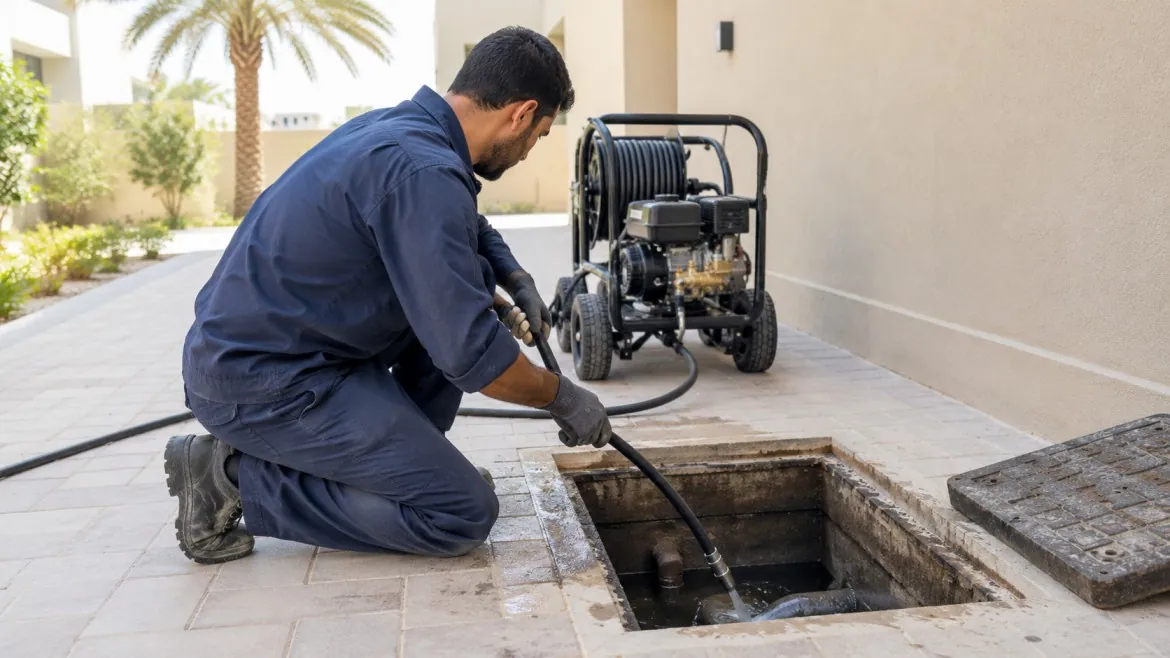
Plumber jetting a kitchen drain line in a Dubai villa with a high-pressure hose

Drain Cleaning Cost in Dubai: What Each Job Type Costs in 2026

Drain Cleaning Cost in Dubai: What Each Job Type Costs in 2026 1170 658 admin

The drain cleaning cost in Dubai runs from about AED 150 to clear a single sink or shower to AED 600–1,500 to jet a villa’s external line and manholes, before 5% VAT. Three things set the price: where the blockage sits, which method clears it, and whether a camera is needed to find it. The table below gives typical prices per job, followed by what pushes a quote up or down.

Drain Cleaning Prices in Dubai by Job Type

These are typical 2026 rates for a standard daytime visit in Dubai. Prices exclude VAT and assume normal access to the drain.

JobTypical price (AED, excl. VAT)Usual methodTime on site
Sink, basin or shower drain150–250Plunger or hand spiral30–60 min
Blocked toilet150–300Toilet auger30–60 min
Floor, balcony or roof drain (per point)150–350Hand clearing and flush30–90 min
Kitchen line, machine clearing250–450Electric drain machine1–2 hours
Kitchen or branch line, jetting400–800High-pressure jetter1–2 hours
Villa external line and manholes600–1,500Jetting and chamber cleaning2–4 hours
CCTV drain inspection500–1,200Camera survey with video1–2 hours
Residential grease trap200–400Manual pump-outAbout 1 hour
Evening, Friday or emergency calloutAdd 100–200——

Most household jobs land in the AED 150–450 band. The bigger numbers come from main lines, villa manholes and commercial kitchens, where a jetting machine or a camera survey is part of the job. If you just want the blockage gone, our drainage cleaning services page explains how a visit works.

What Drives the Cost of Drain Cleaning

Four factors decide the final quote.

  • Where the blockage is. A clog in a basin trap or shower waste is a short job. A blockage in the main line that serves several fixtures takes longer and needs heavier equipment.
  • The method needed. Hand tools and a drain spiral clear most branch lines. Grease-lined kitchen pipes and long villa runs usually need high-pressure jetting, which costs more because of the machine and the water used.
  • Access. Manholes buried under paving, chambers behind fitted cabinets, and apartment buildings that only allow contractors in set hours all add time.
  • Timing and repeat calls. Evening and Friday callouts usually carry a surcharge. A drain that blocks again within weeks needs a camera inspection, which adds to the first bill but stops you paying for the same job twice.

Drain Unblocking vs Drain Jetting: Which One You Need

Drain unblocking means breaking up or pulling out a clog with a plunger, a hand auger or an electric drain machine. It is the right call for hair in a shower, a toilet blocked by wipes, or a basin trap full of soap scum. It opens the pipe but leaves whatever is coating the pipe walls.

Drain jetting uses high-pressure water to scour the full bore of the pipe. In Dubai it is most often booked for kitchen lines coated in cooking fat, villa external lines between manholes, and building drains clogged with sand after rain. Jetting clears what a spiral leaves behind, so the line stays open for longer.

Jetting is not automatically better. On old, cracked or poorly joined pipes, high pressure can make a weak joint worse, so the line should be checked with a camera first if its condition is unknown.

When a CCTV Drain Inspection Is Worth Paying For

A CCTV drain inspection sends a small waterproof camera down the line and records what it finds. It costs more than a basic unblock, but far less than digging up paving in the wrong place. It is worth paying for when:

  • the same drain has blocked two or more times in a few months
  • there is a sewage smell but no visible blockage
  • you are buying a villa or taking handover of a new unit (pair it with a building inspection in Dubai)
  • a renovation has just finished, since tile adhesive, grout and cement often end up in floor drains
  • paving or the ground above a drain line has started to sink

Ask for the video and a short written note of what was found. That record matters if a landlord, developer or contractor has to pay for the repair.

Apartment vs Villa: Who Pays for Drain Cleaning in Dubai

In an apartment, the pipes running from your sinks, shower and toilet to the building’s shared vertical stack usually belong to the unit. The stack, basement lines and building sewer are normally maintained by the building’s facilities management team. If several flats on the same riser back up at once, the problem is almost certainly in the shared line, so report it to the building before paying anyone.

In a villa, everything inside the plot up to the final connection chamber is usually the owner’s to maintain. That includes the manholes and the lines between them.

Tenants should check the maintenance clause in their tenancy contract. Many contracts put minor maintenance on the tenant and major repairs on the landlord, but the wording varies. Landlords who want one point of contact can hand drain upkeep to a property management service.

Grease Trap Cleaning for Dubai Restaurants

Dubai Municipality requires food establishments to install grease traps and keep them cleaned on a regular schedule. Commercial grease trap waste must be collected by approved companies and taken to the grease trap waste recycling plant in Al Aweer, as set out in the Dubai Municipality grease trap guideline. Commercial grease trap cleaning is priced by trap size and emptying frequency, so it is normally quoted as a contract rather than a single visit.

Homes are simpler. A small under-sink grease trap in a villa kitchen can be emptied by a plumber in about an hour, and clearing the kitchen line at the same visit stops the fat moving further down.

When You May Not Need to Pay for Drain Cleaning

Some problems look like a drain job but are not.

  • Smell from an unused bathroom. Floor drains and basin traps hold a little water that blocks sewer gas. In a Dubai summer that water can dry out in a closed-up apartment, letting the smell in. Running the taps and pouring a jug of water into each floor drain usually fixes it.
  • A slow shower. Hair caught in the strainer just below the grate is the usual culprit. Lift the grate and pull it out before calling anyone.
  • Water dripping from the AC. That is a blocked condensate line, which is an AC technician’s job, not a plumber’s. See why your AC is leaking water.

If water rises in one fixture when you use another, or several drains gurgle together, the blockage is further down the line and needs a professional.

How to Keep Drain Cleaning Costs Down

The cheapest drain cleaning cost in Dubai is the visit you never need. Five habits keep it that way.

  • Fit strainers on shower and basin drains and empty them weekly.
  • Wipe cooking fat into the bin instead of rinsing it down the sink.
  • Run water in unused bathrooms every couple of weeks, especially during summer travel.
  • Have villa external lines and kitchen drains jetted once a year as planned maintenance.
  • Skip repeated chemical drain cleaners. They can damage older pipes and seals and rarely clear a main-line blockage.

If you would rather not track it yourself, MRMO’s annual maintenance packages include cleaning and unblocking of roof drains alongside plumbing repairs.

Frequently Asked Questions

How much does drain cleaning cost in Dubai?

Most household drain cleaning in Dubai costs AED 150–450 per visit, before VAT. A villa line with manhole jetting usually costs AED 600–1,500, and a CCTV drain inspection about AED 500–1,200. Main-line, emergency and repeat blockages sit at the higher end.

How much is drain jetting in Dubai?

Jetting a single kitchen or branch line typically costs AED 400–800. Jetting a villa’s external drain run, including the manholes, usually costs AED 600–1,500 depending on length and access.

How long does drain cleaning take?

A single sink, shower or toilet usually takes 30–60 minutes. Jetting a villa’s external drains takes two to four hours. A CCTV inspection adds one to two hours, including time to review the footage with you.

Is drain cleaning included in an annual maintenance contract?

Often, yes. Most Dubai maintenance contracts cover routine unblocking of internal and roof drains, while jetting and CCTV inspections are charged separately. Check the contract’s exclusions list before signing.

Who pays for a blocked drain in a rented apartment in Dubai?

It depends on where the blockage is and what your tenancy contract says. Blockages in your unit’s own pipes are often the tenant’s responsibility. Blockages in the shared stack or building lines are handled by the building’s facilities management.

Are chemical drain cleaners safe to use?

Occasional use on a minor clog is usually fine, but repeated doses can damage older pipes and rubber seals. They also rarely clear a main-line blockage. If a drain is still slow after one try, call a plumber.

How often should drains be cleaned?

Household drains only need attention when they slow down. Kitchen lines and villa external drains benefit from jetting once a year. Restaurant grease traps need emptying on a regular schedule set by trap size and kitchen volume.

Get a Fixed Drain Cleaning Quote from MRMO

MRMO Technical Services has cleared drains for Dubai homes and businesses since 2020, with in-house plumbers and jetting equipment. Tell us which drain is blocked and what you have already tried, and we will confirm the price before we start. Book our drain cleaning service in Dubai, call +971 56 619 3696, or message us on WhatsApp.

Drilling a wall in a Dubai apartment to hang a mirror, with wall plugs and a spirit level on the floor

How to Hang Anything on a Dubai Apartment Wall: Concrete, Block and Gypsum

How to Hang Anything on a Dubai Apartment Wall: Concrete, Block and Gypsum 1075 716 admin

How to hang anything on a wall comes down to one question: what is the wall made of? Dubai apartments use three materials. Reinforced concrete takes standard plugs and heavy loads. Concrete block is hollow inside and needs longer plugs. Gypsum board on metal studs needs cavity fixings or a screw into a stud.

Get the wall wrong and a mirror that would sit happily on concrete can pull straight out of block or gypsum. This guide shows you how to identify your wall in two minutes, which fixing to use on each, what each one can hold, and when it’s smarter to book our general handyman services instead.

Dubai apartment walls and the fixings they need

Wall typeWhere you’ll find itBest everyday fixingRated hold per fixing
Reinforced concreteColumns, around lifts and stairs, some external wallsUniversal nylon plug, hammer drill95 to 110 kg (6 to 8 mm plug)
Hollow concrete blockMost room-dividing and many external wallsLong universal plug that knots in the cavity6 to 10 kg with a standard plug
Gypsum board on metal studsNewer layouts, TV walls, bulkheads, box-outsSpring toggle or metal self-drilling toggle12 to 20 kg (plug or spring toggle); up to 45 kg (heavy metal toggle)

These are manufacturers’ maximum ratings for a single fixing in ideal conditions. Real walls are rarely ideal, so always spread a load across several fixings and plan for well under the rated figure.

Step 1: Identify your wall

You need two minutes, a knuckle and a small drill bit.

  1. Knock. A hollow, drum-like sound that changes every few centimetres is gypsum board. A dull, solid knock is concrete or block.
  2. Check the edges. Look at the wall’s thickness at a door frame or a removed socket plate. Gypsum shows a thin board over a gap; block and concrete look solid.
  3. Drill a pilot hole where the fixing will go, using a 5 or 6 mm bit:
    • The bit breaks through after about 12 mm into empty space, with white powder: gypsum board.
    • Grey dust, and the bit suddenly drops forward into gaps: hollow block.
    • Grey dust, steady hard resistance all the way, and you need hammer mode: concrete.

[embed: node/c94ec95e-25c5]

What comes out of the pilot hole decides the fixing; the hold figures are manufacturer ratings per fixing.

A stud finder helps on gypsum walls: the metal studs behind the board give you a far stronger fixing point than the board alone.

Before you drill: three checks

  • Cables and pipes. Never drill directly above or below a socket or switch, or in line with taps and the toilet cistern. A cable and pipe detector costs less than one repair.
  • Your building’s rules. Many towers limit drilling to set hours, and some ask residents to notify the building before work. Check with your building management.
  • Your tenancy contract. If you rent, check whether you need the landlord’s consent for wall fixings and whether holes must be filled and painted at move-out.

How to hang things on concrete walls

Concrete is the strongest wall in your flat and the hardest to drill. Use a hammer drill with a sharp masonry bit the same diameter as your plug.

  1. Drill to the plug’s length plus a few millimetres.
  2. Clear the dust out of the hole; dust left inside reduces grip.
  3. Tap the plug in flush and drive the screw until it feels firm. Don’t overtighten.

If the bit stops dead and sparks or squeals, you’ve hit steel reinforcement. Stop, move 2 to 3 cm sideways and try again. Never try to drill through rebar.

A quality 6 mm universal plug is rated up to about 95 kg in concrete, and an 8 mm plug up to about 110 kg. That’s enough for heavy mirrors, wall cabinets and most TV brackets, as long as the bracket’s own fixings suit concrete.

How to hang things on block walls

Most Dubai room walls are hollow concrete block, and this is where most fixings fail. The drill passes through a thin outer shell into an empty core, so a short plug has almost nothing to grip. The same universal plug that holds about 95 kg in concrete is rated at only 6 to 10 kg in hollow concrete.

To get a better hold in block:

  • Use a long version of a universal plug (for example 6 x 50 or 8 x 65 mm). These are designed to bridge the shell and knot behind it.
  • Drill without hammer mode once you’re through the plaster, so you don’t shatter the shell around the hole.
  • For anything heavy, like a wall-hung cabinet or a large TV, use resin (chemical) anchors with a mesh sleeve, or have a professional fix it.
  • Use more fixings rather than bigger ones, and spread them across the full width of the item.

How to hang things on gypsum walls

Gypsum board, usually about 12.5 mm thick, is fixed to metal studs typically 400 to 600 mm apart. The board alone is soft, so a normal plug will crumble out of it.

  • Light items such as small frames and clocks: a universal plug that folds behind the board, rated around 12 to 15 kg.
  • Medium items such as mirrors, curtain rods and light shelves: spring toggles, rated around 17 to 20 kg each in 12.5 mm board.
  • Heavier items: metal self-drilling toggles, rated up to 45 kg each in plasterboard.
  • TVs, wall cabinets and heavy shelves: fix into the metal studs, or open the wall and add plywood backing between them. If you’re planning gypsum work or an interior renovation, ask for backing to be built in wherever a TV or cabinet will go.

Never hang anything that pulls outward, like a swing-arm TV mount, on board fixings alone. Those mounts lever the wall every time they move.

What to use for common items

ItemConcreteBlockGypsum board
Picture frames, clocksStandard plugStandard or long plugFolding plug
MirrorsStandard plugs, 2 or moreLong plugs, 2 or moreSpring toggles, or into studs
Curtain rods and blindsStandard plugsLong plugsSpring toggles, or into studs
Floating shelvesLong screws, standard plugsResin anchorsInto studs only
Fixed TV bracketStandard plugs, bracket’s boltsResin anchorsStuds or plywood backing
Swing-arm TV bracketHeavy-duty anchorsResin anchorsProfessional fit only
Wall cabinetsHeavy-duty anchorsResin anchorsStuds or plywood backing
Baby gates, anti-tip strapsStandard plugsLong plugsInto studs

For shelving that has to carry books or kitchenware, custom shelving with concealed brackets fixed to the right points is often the better fix.

Step-by-step: hanging something safely

  1. Weigh the item, or check the weight on its box.
  2. Mark the positions with a pencil and a spirit level.
  3. Check the spot with a cable and pipe detector.
  4. Drill a small pilot hole to confirm the wall type.
  5. Choose a fixing rated well above the item’s weight, shared across all fixings.
  6. Drill to size, clean the hole and fit the plug or toggle.
  7. Fix the item, then pull firmly downward before letting go.

When to call a handyman

Book a professional when the item is heavy or expensive, when it moves (swing-arm TV mounts, gates), when it goes on a tiled wall where a cracked tile is hard to replace, or when you can’t find the studs in a gypsum wall. The same goes for anything overhead, such as hanging lights or plants from a ceiling.

MRMO Technical Services handles picture hanging and TV mounting alongside curtains and blinds, shelving, baby gates and move-out repairs. We identify the wall, bring the right fixings and fill and touch up any test holes.

Call [phone] or WhatsApp [number] to book a handyman visit.

Frequently asked questions

How do I know if my Dubai apartment wall is concrete, block or gypsum?

Knock first: a hollow, changing sound means gypsum board. Then drill a small pilot hole. White powder and a break-through after about 12 mm is gypsum; grey dust with sudden drops is hollow block; steady hard grey dust is concrete.

What wall plugs work in gypsum board?

Standard expanding plugs don’t hold in gypsum. Use folding universal plugs for light items, spring toggles for medium loads, and metal self-drilling toggles for heavier items. TVs and cabinets should go into the metal studs or onto plywood backing.

How much weight can a gypsum wall hold?

It depends on the fixing, not the board. Folding plugs are rated around 12 to 15 kg each, spring toggles around 17 to 20 kg, and heavy metal toggles up to 45 kg in plasterboard. Fixing into the metal studs carries more.

Why do wall plugs keep falling out of my wall?

You’re probably drilling into hollow block or gypsum with a plug made for solid walls. Switch to a long plug for block, or a cavity fixing for gypsum, and make sure the hole isn’t oversized.

Can I mount a TV on a gypsum wall?

Yes, if the bracket is fixed into the metal studs or onto plywood backing behind the board. Don’t hang a TV, especially on a swing-arm bracket, from board fixings alone.

What do I do if I hit metal while drilling into concrete?

Stop. You’ve hit reinforcing steel. Move 2 to 3 cm to one side and drill again, and fill the abandoned hole.

Do I need permission to drill walls in a rented Dubai apartment?

Check your tenancy contract and your building’s rules. Many landlords allow small fixings but expect holes to be filled and painted at move-out, and many buildings restrict drilling hours.

Is it safe to drill near sockets and switches?

Avoid drilling directly above, below or beside sockets and switches, where cables usually run. Use a cable and pipe detector before every hole.