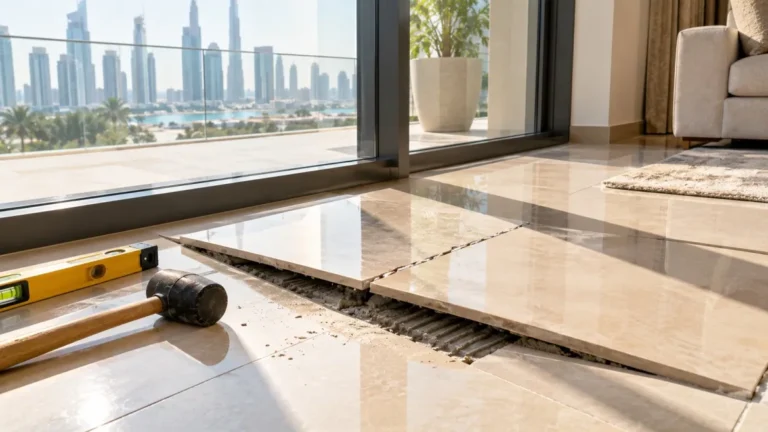
Tiles popping up in a Dubai home are almost always caused by one of three things: no movement joints to absorb heat expansion, too little adhesive under each tile, or water getting underneath. A hollow sound when you tap a tile is the early warning; lifting, cracking or a “tent” of raised tiles is the late stage. Fixing a few loose tiles usually costs a few hundred dirhams; relaying a section runs from about AED 100 per square metre plus new tiles.
The Six Most Common Causes
Most failing floors have more than one of these at work.
- No movement joints. Tiles expand and contract with temperature. In Dubai, floors near glass doors and terraces swing between strong sun and air-conditioned cool every day. Without flexible joints, the pressure builds until tiles lift or crack. A UAE tile supplier recommends joints every 6–8 m indoors and every 3–4 m outdoors, plus at doorways and around the room’s edge (Al Shabib Trading).
- Too little adhesive. Fixing tiles on a few dabs of adhesive instead of a full bed leaves air pockets. Those tiles sound hollow from day one and crack when furniture or foot traffic loads the unsupported corners.
- Tiling over a screed that was not ready. A sand-and-cement screed needs time to cure and dry. Tiling over it too soon, or over a cracked or uneven base, passes every movement straight to the tiles.
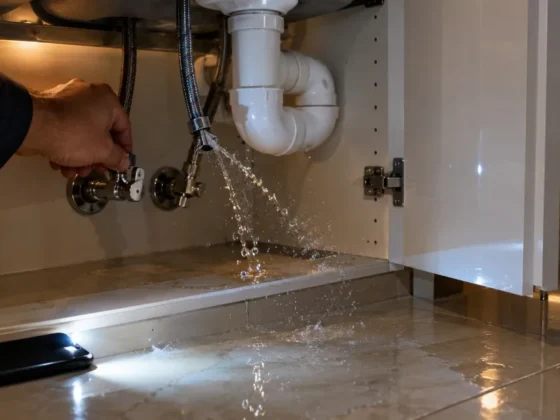
- Water underneath. A failed shower waterproofing membrane, a leaking pipe under the floor or a dripping AC drain line can saturate the bed. The adhesive weakens and the tiles loosen, often with dark grout or a damp smell first.
- Large tiles on an uneven floor. 60×120 cm and larger tiles need a very flat base. On an uneven screed they rock, sound hollow at the corners and chip at the edges.
- Impact. A dropped pan or tool can crack a single tile, especially one that was already hollow underneath.
How to Check Your Own Floor
You can find most problems in ten minutes with a coin or the handle of a screwdriver.
- Tap test. Tap across each tile. A solid “click” means it is well bonded; a hollow, drummy sound means there is air underneath.
- Look at the grout. Cracked or crumbling grout in a straight line often follows a crack in the screed below.
- Check the edges. Lift the skirting silicone or look at the gap at the wall. If tiles are tight against the wall with no gap, there is nowhere for expansion to go.
- Look for a pattern. One cracked tile is usually impact. A row of tiles lifting across a room points to missing movement joints. Loose tiles around a shower or under a sink point to water.
A few hollow tiles are common and not urgent. Hollow tiles spreading across a room, or tiles that move under your foot, should be fixed before they crack and leave sharp edges.
What Tile Repairs Cost in Dubai
These are typical 2026 prices before VAT. Repair prices are market estimates for Dubai; relaying costs combine published labour and material rates.
| Repair | Typical cost (AED, excl. VAT) | Notes |
|---|---|---|
| Replace 1–3 cracked tiles (spare tiles available) | 150–400 per visit | Matching tiles are the main challenge |
| Re-fix loose or hollow tiles | 60–120 per tile | Lift, clean, re-bed and regrout |
| Regrout a bathroom | 400–900 | Depends on size and grout type |
| Add movement joints or redo perimeter silicone | 15–30 per linear metre | Often fixes recurring “tenting” |
| Relay a section: remove, re-screed if needed, refix | 100–200 per m², plus new tiles | Labour about AED 40–85/m²; removal AED 15–30/m² |
| New porcelain tiles (supply only) | 40–180 per m² | Standard 60×60 cm at the lower end |
Labour rates of AED 40–85 per m² for ceramic and porcelain come from published Dubai tile fixing rates (Tile Fixing Rates in Dubai). Removal and tile supply costs come from a UAE tile retailer (Tile Mountain). For a fixed price on your own floor, see our tile work in Dubai page.
Repair a Few Tiles or Relay the Floor?
Repair is the right call when the problem is limited: a handful of hollow or cracked tiles, no pattern, and spare tiles from the same batch.
Relaying is better when:
- hollow tiles are spread across most of the room
- tiles keep lifting after earlier repairs, which usually means missing movement joints or a failed screed
- water has got under a bathroom floor, since the waterproofing has to be redone before new tiles go down
- you cannot find matching tiles and a patch would look obviously different
If you are already planning a renovation, relay the floor as part of it rather than paying for repairs first.
Stop Water Before You Fix the Tiles
Re-fixing tiles over a wet bed is wasted money; they will loosen again. If loose tiles are near a shower, bath, kitchen sink or an indoor AC unit, find the water first.
- Around showers and baths, the waterproofing membrane under the tiles may have failed. A plumber can pressure-test the pipes and check the waste connections; see our plumbing work service.
- Near an indoor AC unit, a blocked condensate line can drip into the wall and floor. Our guide to why your AC is leaking water covers the fix.
New Home? Check the Tiles at Handover
Hollow tiles are one of the most common snags in new Dubai apartments and villas. Check them before handover, while the developer is still responsible. A building inspection tap-tests every floor and records the hollow tiles room by room, so the developer can fix them under warranty.
How to Prevent Tiles Popping Up Again
- Insist on full adhesive coverage, back-buttering large tiles so there are no air pockets.
- Leave movement joints at the perimeter, doorways and across large or sunlit floors, filled with flexible sealant instead of grout.
- Let the screed cure before tiling.
- Waterproof every wet area before tiling, and test it.
- Keep 5–10% spare tiles from the original batch, labelled, so future repairs match.
Frequently Asked Questions
Why are my floor tiles popping up?
Usually because there are no movement joints to absorb heat expansion, the tiles were fixed with too little adhesive, or water has got underneath. In Dubai, sunlit floors next to air-conditioned rooms are especially prone to it.
Are hollow-sounding tiles a problem?
A few are common and not urgent. Many hollow tiles, or hollow tiles that are spreading or moving underfoot, mean the bond is failing and the tiles are likely to crack or lift.
How much does it cost to fix loose tiles in Dubai?
Re-fixing a loose or hollow tile typically costs AED 60–120 per tile before VAT. Replacing one to three cracked tiles usually costs AED 150–400 per visit, provided matching spare tiles are available.
Can a single cracked tile be replaced?
Yes. A technician cuts out the grout, lifts the cracked tile, cleans the bed and fixes a new tile in its place. The hard part is finding a matching tile, which is why it pays to keep spares.
What is tile tenting?
Tenting is when tiles push against each other and lift into a raised ridge, sometimes with a loud crack. It is usually caused by thermal expansion with no movement joints to absorb it.
How long does tile repair take?
Replacing a few tiles takes a few hours, though the grout needs about a day before heavy use. Relaying a room usually takes two to four days, longer if the screed needs replacing.
Book a Tile Inspection with MRMO
MRMO Technical Services repairs and relays tiles across Dubai, with in-house tilers and plumbers to find and fix the cause, not just the cracked tile. We tap-test the floor, show you what we find and give you a fixed price before any work starts. Book on our tile work in Dubai page, call +971 56 619 3696, or message us on WhatsApp.