


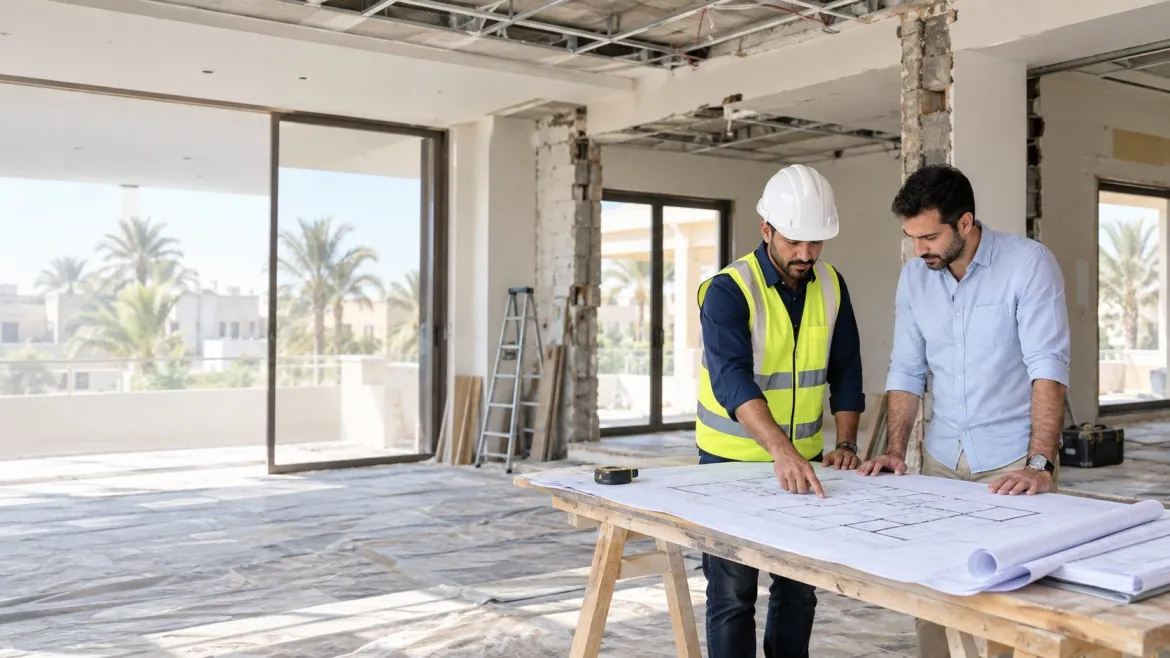
Cosmetic work such as painting, re-tiling over existing floors or swapping fixtures usually needs only your building or community’s permission. Anything that touches structure, layout, MEP systems, fire safety or the exterior needs a developer NOC and an authority permit from Dubai Municipality, Trakhees or DDA. It may also need DEWA and Dubai Civil Defence approval. Which of these apply depends on two things: where your property sits and what you are changing.
Most homeowners over-plan or under-plan. Some chase five approvals for a bathroom refresh. Others knock down a wall on a weekend and meet a stop-work notice on Monday. This guide shows you how to work out your own list in about five minutes.
Do You Need a Renovation Permit in Dubai?
You need a formal renovation permit in Dubai when your work affects the building’s structure, internal layout, mechanical, electrical or plumbing (MEP) systems, fire and life-safety systems, or external appearance. Purely cosmetic work generally does not need an authority permit. It may still need a work permit or NOC from your building management or master developer.
| Type of work | Authority permit? | Developer / building NOC? |
|---|---|---|
| Painting walls (same colour scheme inside) | No | Usually a simple work permit |
| Replacing sanitary fittings, taps, light fixtures | No | Usually a work permit |
| Re-tiling or new flooring (no level change) | Rarely | Yes, in most towers and communities |
| New kitchen cabinets in the same position | Rarely | Yes |
| Moving a kitchen or bathroom (wet area relocation) | Yes | Yes |
| Removing or adding internal walls | Yes | Yes |
| New false ceiling that moves detectors or sprinklers | Yes, plus Civil Defence | Yes |
| Increasing electrical load, new DB or AC units | Yes, plus DEWA | Yes |
| Extension, pergola, pool, boundary wall, facade | Yes | Yes |
| Change of use (e.g. retail to clinic) | Yes, plus DCD and sector authority | Yes |
Step One: Find Out Which Authority Covers Your Property
Dubai does not have a single permitting body for every plot. Your property’s jurisdiction decides which portal your contractor submits to and which drawing format is accepted. Check your affection plan or ask your developer before any drawings are prepared.
Dubai Municipality (DM)
Dubai Municipality issues building and renovation permits across most of mainland Dubai. That includes areas such as Business Bay, Downtown Dubai, Al Barsha, Jumeirah, Deira and Bur Dubai. Applications run through the Dubai Building Permit System (BPS) and are reviewed against the Dubai Building Code.
Trakhees (PCFC)
Trakhees, the regulator under the Ports, Customs and Free Zone Corporation, handles permits in designated zones. These include Palm Jumeirah, Jumeirah Islands, Jumeirah Park, Al Furjan, Discovery Gardens, International City and JAFZA. Its Civil Engineering Department (CED) reviews structure and design. Its EHS team covers health, safety and fire. Trakhees drawing formats differ from DM’s, so a set prepared for one will not pass the other.
Dubai Development Authority (DDA)
DDA regulates construction and fit-out in its own zones, including business districts such as Dubai Internet City, Dubai Media City and Dubai Design District. It issues its own fit-out permits through an online portal.
Watch out: jurisdiction does not always follow the developer’s name. Some Nakheel communities fall under Trakhees and others do not. Confirm the plot, not the brand.
Step Two: Get the Developer or Building NOC First
A No Objection Certificate (NOC) from your master developer or building management confirms your plans respect community rules: materials, colours, wall heights, working hours and common-area protection. It is not a building permit. It is, however, the document the authority expects to see before it starts its own review.
- Villas in gated communities: apply to the master developer or community management, such as Emaar, Nakheel, DAMAC, Meraas or Dubai Properties. Most run an online home modification portal.
- Apartments: start with building management or the owners association. The master developer may also need to sign off.
- Mainland villas outside a masterplan: there is usually no developer layer. You go straight to Dubai Municipality.
- Tenants: you need the landlord’s written consent before any NOC application. Without it, no developer or authority will process the request.
Developers commonly take a refundable security deposit to cover damage to common areas. It is returned after a completion inspection. Nakheel communities, for example, are widely reported to require deposits of roughly AED 5,000 to 20,000 depending on scope.
Step Three: The Authority Permit
Once the NOC is in hand, your contractor or consultant submits the permit application to DM, Trakhees or DDA. For renovation this usually falls into one of three categories:
- Fit-out permit for non-structural interior work: partitions, ceilings, finishes and MEP changes within a unit.
- Modification or renovation permit for changes to structure, layout or the building envelope.
- Addition or extension permit for new built-up area, such as an extra room, a covered terrace or a pool structure.
What a typical submission includes
- Title deed or tenancy contract with landlord consent
- Developer or building NOC
- Affection plan
- Architectural drawings of existing and proposed layouts
- MEP drawings where services change
- Structural calculations or an engineer’s report for any load-bearing change
- Trade licence of the registered contractor and consultant
- Owner’s passport and Emirates ID copies
- Soil investigation report for extensions
Step Four: DEWA and Dubai Civil Defence
These two approvals only apply when your scope touches their systems. They can usually run in parallel with the main permit.
DEWA approval
DEWA controls electrical load, meter allocation and water connections. You need its approval when a renovation adds significant load (new AC units, a larger kitchen, an EV charger), relocates the main distribution board or changes water connections. Electrical work should be carried out by a DEWA-approved contractor. See our electrical services in Dubai page for what that involves.
Dubai Civil Defence (DCD) approval
DCD approval is needed when work affects fire alarms, sprinklers, emergency lighting, exit signage or escape routes. This is common in commercial fit-outs. In homes it is often triggered by a new false ceiling that relocates smoke detectors, or by open-plan conversions. Drawings must follow the UAE Fire and Life Safety Code and be prepared by a DCD-approved contractor.
What Changed in 2026: Contractors Must Be on the DM Register
Dubai Law No. 7 of 2025, which regulates contracting activities, came into force on 8 January 2026. It creates a single contractor register managed by Dubai Municipality. It applies across the emirate, including free zones such as DIFC.
What this means for homeowners:
- Check registration before you sign. Contractors must be registered and classified. They may only take on work within their classification.
- Subcontracting needs approval. A main contractor cannot quietly hand your job to an unlicensed crew.
- There is a transition window. Existing contractors have until 8 January 2027 to comply.
- Penalties are real. Contractors face fines from AED 1,000 to AED 100,000 per violation, doubling for repeats within a year, plus suspension or removal from the register.
For you, the practical takeaway is simple. A cheap quote from an unregistered crew is now a legal risk, not just a quality risk.
Which Approvals Does Your Project Need? Five Common Scenarios
| Scenario | Approvals typically needed |
|---|---|
| Apartment: new kitchen in the same spot, new flooring, paint | Building management work permit / NOC |
| Apartment: open-plan living by removing a partition wall | Building NOC, developer NOC, DM (or Trakhees/DDA) permit, possibly DCD |
| Emaar villa: kitchen extension into the garden | Emaar NOC, DM permit, DEWA if load increases, DCD for structural work |
| Palm Jumeirah villa: interior strip-out and full remodel | Nakheel NOC with deposit, Trakhees CED permit, DCD, DEWA |
| Office in Business Bay: new partitions and ceilings | Landlord NOC, DM fit-out permit, DCD, DEWA if load changes |
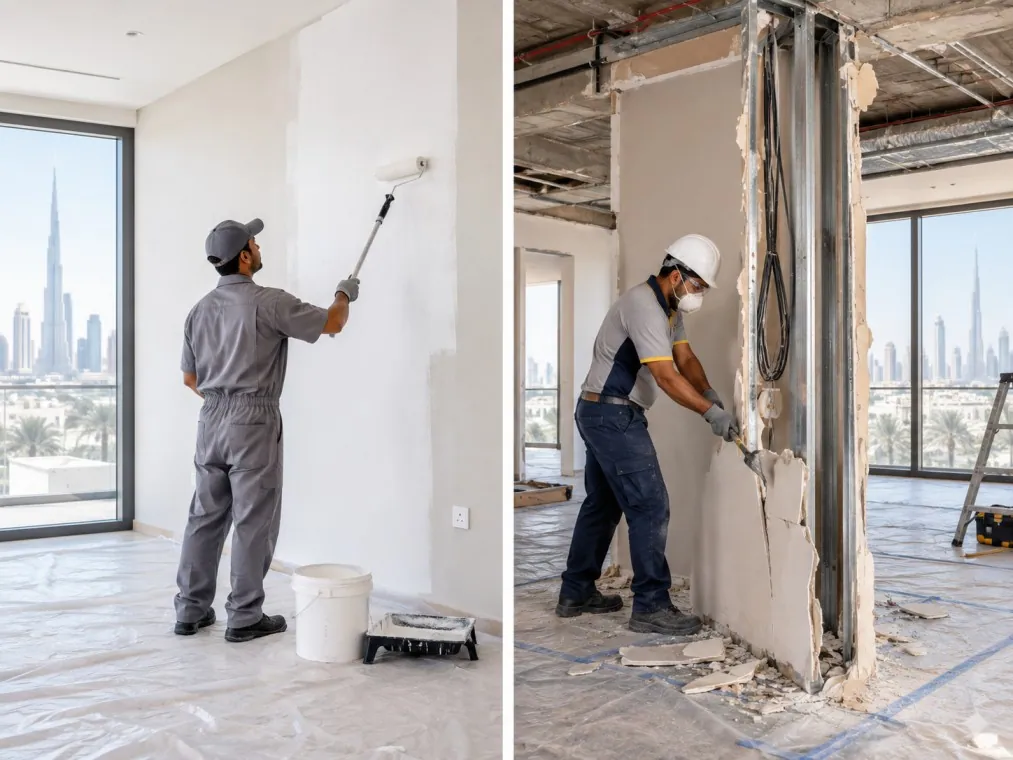
If your job involves stripping out old finishes or walls, see how a controlled interior strip-out and demolition fits into the permit sequence.
How Long Do Renovation Approvals Take?
Timelines depend on scope and how complete the first submission is. Approval consultants commonly report these ranges:
| Approval | Typical time |
|---|---|
| Building or community work permit (cosmetic) | 3 to 7 working days |
| Developer NOC | 5 to 15 working days |
| DM minor renovation permit | About 1 to 2 weeks |
| DM or Trakhees permit with structural drawings | 2 to 6 weeks |
| DEWA approval | 5 to 20 working days, often in parallel |
| DCD drawing approval | 7 to 14 working days |
The biggest cause of delay is a missing document. An incomplete submission usually resets the review clock.
How Much Do Renovation Permits Cost in Dubai?
There is no single fee. Authority fees depend on the area being modified and the permit category, and are confirmed during review. As a rough guide, consultants report:
- Developer NOC admin fees of around AED 2,000 to 5,000
- Refundable security deposits from around AED 2,000 to 20,000
- DM or Trakhees permit fees for villa renovations from around AED 2,000 to 15,000
- Consultant drawing fees on top for structural projects
Treat these as indicative. Your consultant should confirm exact fees at submission.
What Happens If You Renovate Without Approval?
Skipping approvals rarely saves money. The common consequences are:
- Stop-work orders from the authority or the community
- Fines for the owner and the contractor
- Forced restoration of the original layout at your cost
- Forfeited security deposits and blocked future NOC applications
- Resale problems, because developer clearance and transfer checks can flag unapproved changes
- Insurance gaps if an unapproved change is linked to damage
Your Renovation Permit Checklist
- Confirm your authority (DM, Trakhees or DDA) from the affection plan.
- Classify the work: cosmetic, fit-out, structural or extension.
- Get landlord consent if you are a tenant.
- Apply for the developer or building NOC.
- Hire a contractor listed on the Dubai Municipality contractor register.
- Submit the authority permit with complete drawings.
- Add DEWA and DCD approvals if your scope touches their systems.
- Keep permits on site and pass stage inspections.
- Close out with the completion inspection and recover your deposit.
Plan Your Renovation With MRMO
MRMO Technical Services has delivered renovation, fit-out and maintenance work across Dubai since 2020. Before we quote, we confirm your property’s jurisdiction and tell you which approvals your scope triggers. That way the programme and the paperwork line up from day one.
4. FAQ’s
Place after the checklist, before the MRMO CTA. Each answer opens with a direct sentence so it can be lifted as a snippet. The same wording goes into the FAQPage schema.
Do I need a permit to renovate my apartment in Dubai?
You need a permit if the work changes walls, wet areas, MEP systems or fire safety equipment. Cosmetic work such as painting, new fixtures or cabinet replacement usually needs only a work permit from building management. Always check your building’s rules first, because many towers require approval even for minor works.
Can I remove a wall in my Dubai apartment or villa?
Only with approval. Removing any wall needs a developer or building NOC and an authority permit, even if the wall is not load-bearing. Load-bearing walls also need a structural engineer’s report, and open-plan conversions may need Civil Defence review.
Who applies for the renovation permit, me or the contractor?
The registered contractor or engineering consultant submits the authority application. As the owner, you supply the title deed, ID copies and a signed authorisation. For the developer NOC, owners often apply directly through the developer’s portal.
Is Dubai Municipality approval the same as a developer NOC?
No. A developer NOC confirms your plans follow community rules. A Dubai Municipality, Trakhees or DDA permit is the legal authorisation to build. In gated communities you normally need the NOC first, then the permit.
Is Palm Jumeirah under Dubai Municipality?
No. Palm Jumeirah falls under Trakhees. Renovations there need a Nakheel NOC followed by a Trakhees CED permit, plus Civil Defence approval where fire or structural works are involved.
Can tenants renovate a rented property in Dubai?
Yes, with the landlord’s written consent. The landlord’s approval comes first, then the building or developer NOC, then any authority permit the scope requires.
How do I check if a contractor is registered in Dubai?
Ask for the contractor’s trade licence and confirm it is on the Dubai Municipality contractor register created under Law No. 7 of 2025. A registered contractor should also be able to show its classification level and, for electrical work, DEWA approval.
Do I need a permit for a pergola or outdoor kitchen?
In most gated communities, yes. Pergolas, outdoor kitchens, hard landscaping and boundary wall changes usually need a developer NOC. Fixed structures or those adding built-up area typically need an authority permit too.