


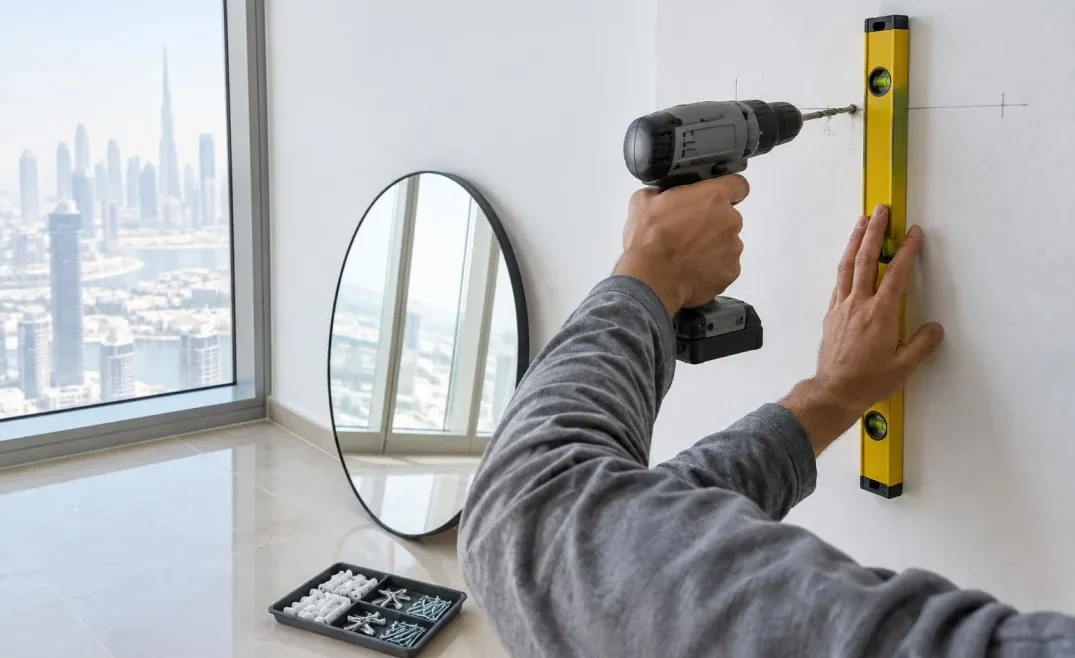
How to hang anything on a wall comes down to one question: what is the wall made of? Dubai apartments use three materials. Reinforced concrete takes standard plugs and heavy loads. Concrete block is hollow inside and needs longer plugs. Gypsum board on metal studs needs cavity fixings or a screw into a stud.
Get the wall wrong and a mirror that would sit happily on concrete can pull straight out of block or gypsum. This guide shows you how to identify your wall in two minutes, which fixing to use on each, what each one can hold, and when it’s smarter to book our general handyman services instead.
Dubai apartment walls and the fixings they need
| Wall type | Where you’ll find it | Best everyday fixing | Rated hold per fixing |
|---|---|---|---|
| Reinforced concrete | Columns, around lifts and stairs, some external walls | Universal nylon plug, hammer drill | 95 to 110 kg (6 to 8 mm plug) |
| Hollow concrete block | Most room-dividing and many external walls | Long universal plug that knots in the cavity | 6 to 10 kg with a standard plug |
| Gypsum board on metal studs | Newer layouts, TV walls, bulkheads, box-outs | Spring toggle or metal self-drilling toggle | 12 to 20 kg (plug or spring toggle); up to 45 kg (heavy metal toggle) |
These are manufacturers’ maximum ratings for a single fixing in ideal conditions. Real walls are rarely ideal, so always spread a load across several fixings and plan for well under the rated figure.
Step 1: Identify your wall
You need two minutes, a knuckle and a small drill bit.
- Knock. A hollow, drum-like sound that changes every few centimetres is gypsum board. A dull, solid knock is concrete or block.
- Check the edges. Look at the wall’s thickness at a door frame or a removed socket plate. Gypsum shows a thin board over a gap; block and concrete look solid.
- Drill a pilot hole where the fixing will go, using a 5 or 6 mm bit:
- The bit breaks through after about 12 mm into empty space, with white powder: gypsum board.
- Grey dust, and the bit suddenly drops forward into gaps: hollow block.
- Grey dust, steady hard resistance all the way, and you need hammer mode: concrete.
[embed: node/c94ec95e-25c5]
What comes out of the pilot hole decides the fixing; the hold figures are manufacturer ratings per fixing.
A stud finder helps on gypsum walls: the metal studs behind the board give you a far stronger fixing point than the board alone.
Before you drill: three checks
- Cables and pipes. Never drill directly above or below a socket or switch, or in line with taps and the toilet cistern. A cable and pipe detector costs less than one repair.
- Your building’s rules. Many towers limit drilling to set hours, and some ask residents to notify the building before work. Check with your building management.
- Your tenancy contract. If you rent, check whether you need the landlord’s consent for wall fixings and whether holes must be filled and painted at move-out.
How to hang things on concrete walls
Concrete is the strongest wall in your flat and the hardest to drill. Use a hammer drill with a sharp masonry bit the same diameter as your plug.
- Drill to the plug’s length plus a few millimetres.
- Clear the dust out of the hole; dust left inside reduces grip.
- Tap the plug in flush and drive the screw until it feels firm. Don’t overtighten.
If the bit stops dead and sparks or squeals, you’ve hit steel reinforcement. Stop, move 2 to 3 cm sideways and try again. Never try to drill through rebar.
A quality 6 mm universal plug is rated up to about 95 kg in concrete, and an 8 mm plug up to about 110 kg. That’s enough for heavy mirrors, wall cabinets and most TV brackets, as long as the bracket’s own fixings suit concrete.
How to hang things on block walls
Most Dubai room walls are hollow concrete block, and this is where most fixings fail. The drill passes through a thin outer shell into an empty core, so a short plug has almost nothing to grip. The same universal plug that holds about 95 kg in concrete is rated at only 6 to 10 kg in hollow concrete.
To get a better hold in block:
- Use a long version of a universal plug (for example 6 x 50 or 8 x 65 mm). These are designed to bridge the shell and knot behind it.
- Drill without hammer mode once you’re through the plaster, so you don’t shatter the shell around the hole.
- For anything heavy, like a wall-hung cabinet or a large TV, use resin (chemical) anchors with a mesh sleeve, or have a professional fix it.
- Use more fixings rather than bigger ones, and spread them across the full width of the item.
How to hang things on gypsum walls
Gypsum board, usually about 12.5 mm thick, is fixed to metal studs typically 400 to 600 mm apart. The board alone is soft, so a normal plug will crumble out of it.
- Light items such as small frames and clocks: a universal plug that folds behind the board, rated around 12 to 15 kg.
- Medium items such as mirrors, curtain rods and light shelves: spring toggles, rated around 17 to 20 kg each in 12.5 mm board.
- Heavier items: metal self-drilling toggles, rated up to 45 kg each in plasterboard.
- TVs, wall cabinets and heavy shelves: fix into the metal studs, or open the wall and add plywood backing between them. If you’re planning gypsum work or an interior renovation, ask for backing to be built in wherever a TV or cabinet will go.
Never hang anything that pulls outward, like a swing-arm TV mount, on board fixings alone. Those mounts lever the wall every time they move.
What to use for common items
| Item | Concrete | Block | Gypsum board |
|---|---|---|---|
| Picture frames, clocks | Standard plug | Standard or long plug | Folding plug |
| Mirrors | Standard plugs, 2 or more | Long plugs, 2 or more | Spring toggles, or into studs |
| Curtain rods and blinds | Standard plugs | Long plugs | Spring toggles, or into studs |
| Floating shelves | Long screws, standard plugs | Resin anchors | Into studs only |
| Fixed TV bracket | Standard plugs, bracket’s bolts | Resin anchors | Studs or plywood backing |
| Swing-arm TV bracket | Heavy-duty anchors | Resin anchors | Professional fit only |
| Wall cabinets | Heavy-duty anchors | Resin anchors | Studs or plywood backing |
| Baby gates, anti-tip straps | Standard plugs | Long plugs | Into studs |
For shelving that has to carry books or kitchenware, custom shelving with concealed brackets fixed to the right points is often the better fix.
Step-by-step: hanging something safely
- Weigh the item, or check the weight on its box.
- Mark the positions with a pencil and a spirit level.
- Check the spot with a cable and pipe detector.
- Drill a small pilot hole to confirm the wall type.
- Choose a fixing rated well above the item’s weight, shared across all fixings.
- Drill to size, clean the hole and fit the plug or toggle.
- Fix the item, then pull firmly downward before letting go.
When to call a handyman
Book a professional when the item is heavy or expensive, when it moves (swing-arm TV mounts, gates), when it goes on a tiled wall where a cracked tile is hard to replace, or when you can’t find the studs in a gypsum wall. The same goes for anything overhead, such as hanging lights or plants from a ceiling.
MRMO Technical Services handles picture hanging and TV mounting alongside curtains and blinds, shelving, baby gates and move-out repairs. We identify the wall, bring the right fixings and fill and touch up any test holes.
Call [phone] or WhatsApp [number] to book a handyman visit.
Frequently asked questions
How do I know if my Dubai apartment wall is concrete, block or gypsum?
Knock first: a hollow, changing sound means gypsum board. Then drill a small pilot hole. White powder and a break-through after about 12 mm is gypsum; grey dust with sudden drops is hollow block; steady hard grey dust is concrete.
What wall plugs work in gypsum board?
Standard expanding plugs don’t hold in gypsum. Use folding universal plugs for light items, spring toggles for medium loads, and metal self-drilling toggles for heavier items. TVs and cabinets should go into the metal studs or onto plywood backing.
How much weight can a gypsum wall hold?
It depends on the fixing, not the board. Folding plugs are rated around 12 to 15 kg each, spring toggles around 17 to 20 kg, and heavy metal toggles up to 45 kg in plasterboard. Fixing into the metal studs carries more.
Why do wall plugs keep falling out of my wall?
You’re probably drilling into hollow block or gypsum with a plug made for solid walls. Switch to a long plug for block, or a cavity fixing for gypsum, and make sure the hole isn’t oversized.
Can I mount a TV on a gypsum wall?
Yes, if the bracket is fixed into the metal studs or onto plywood backing behind the board. Don’t hang a TV, especially on a swing-arm bracket, from board fixings alone.
What do I do if I hit metal while drilling into concrete?
Stop. You’ve hit reinforcing steel. Move 2 to 3 cm to one side and drill again, and fill the abandoned hole.
Do I need permission to drill walls in a rented Dubai apartment?
Check your tenancy contract and your building’s rules. Many landlords allow small fixings but expect holes to be filled and painted at move-out, and many buildings restrict drilling hours.
Is it safe to drill near sockets and switches?
Avoid drilling directly above, below or beside sockets and switches, where cables usually run. Use a cable and pipe detector before every hole.