


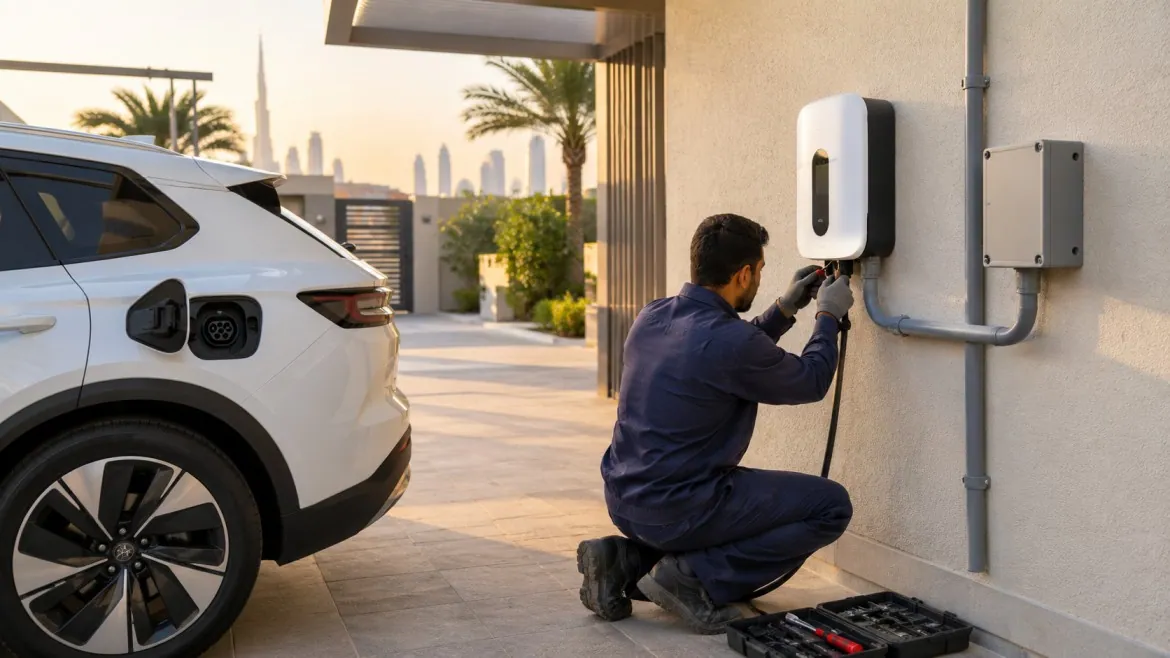
The EV charger installation cost in Dubai is usually AED 3,500–6,000 for a 7.4 kW wallbox in a villa, charger and installation included, before VAT. Apartments cost more, typically AED 5,000–10,000, because of the cable run to a basement bay, a sub-meter and building approvals. Where you park, how far the charger sits from your distribution board, and whether the board needs an upgrade decide where you land in that range.
EV Charger Installation Prices in Dubai
These are typical 2026 prices for home and small commercial installations in Dubai, before 5% VAT. Totals include the charger unit unless stated.
| Installation | Typical total (AED, excl. VAT) | What drives the price |
|---|---|---|
| Villa, 7.4 kW wallbox, charger within 10 m of the DB | 3,500–6,000 | Charger brand, cable size, protection devices |
| Villa, 11 kW three-phase wallbox | 4,500–7,500 | Three-phase supply, heavier cable |
| Villa, long run or trenching across the driveway | 6,000–9,000 | Cable length, ducting, paving reinstatement |
| Apartment, basement parking bay | 5,000–10,000 | Cable route, sub-meter, building NOC |
| Installation only, customer supplies charger | 1,500–3,500 | Labour, cable, breaker and RCD |
| Distribution board upgrade (if needed) | Add 800–3,000 | Spare capacity in the existing board |
| Office or retail, 22 kW AC per point | Quoted per site | Number of points, load management, DEWA submission |
Most villa owners pay toward the lower end, because the garage or car porch is usually close to the main board. If you want MRMO to price your own site, our electric car charger installation page explains how the free survey works.
What an Installation Quote Should Include
A fair quote lists every part of the job, so you can compare contractors line by line. Expect to see:
- The charger unit, with brand, model and power rating (7.4 kW, 11 kW or 22 kW).
- Cable and containment, priced by length, with the cable size stated.
- Protection devices: a dedicated breaker and the residual current protection the charger requires.
- Mounting and weatherproofing. Chargers in Dubai sit in heat, dust and direct sun, so an outdoor unit should carry at least an IP65 rating.
- Testing and commissioning, including setting up the charger’s app if it has one.
- DEWA paperwork, where the job adds load or changes the supply.
If a quote is a single lump sum with no breakdown, ask for one. Hidden extras usually appear later as “additional cable” or “board modification”.
What Pushes the Price Up
Four things move a quote more than the charger brand does.
- Distance from the distribution board. Every extra metre adds cable, containment and labour. A charger on the far side of a villa driveway can cost twice as much as one on the garage wall next to the board.
- Spare capacity in your board. Older villas sometimes lack space or capacity for a new circuit. Adding a breaker is cheap; replacing or upgrading the board is not.
- Three-phase supply. An 11 kW or 22 kW charger needs three-phase power. Most Dubai villas have it, but if yours does not, a 7.4 kW single-phase charger is the practical choice.
- Civil work. Cutting into interlock paving, trenching or core-drilling through a wall adds cost and time. Planning the charger during a villa renovation avoids most of it.
7.4 kW vs 11 kW vs 22 kW: Does a Bigger Charger Cost More?
Yes, but only by a little on hardware. The real difference is the supply. A 7.4 kW charger runs on single-phase power and adds roughly 40–50 km of range per hour, which refills most daily driving overnight. An 11 kW charger needs three-phase power and costs about AED 1,000–1,500 more to install. A 22 kW charger only makes sense if your car can accept 22 kW on AC, and many cannot.
For most Dubai homes, 7.4 kW is enough. Choose 11 kW if you have three-phase power and two EVs sharing one charger, or a long daily commute.
Installing an EV Charger in a Dubai Apartment
Apartment installations are possible, but they take more paperwork than a villa. Expect three requirements:
- A No Objection Certificate (NOC) from the building management or owners’ association.
- A dedicated parking bay assigned to your unit, so the cable is not run to a shared space.
- A metering arrangement. The charger is normally wired to your own unit’s supply or fitted with a sub-meter, so the building can bill you for what you use.
The cable route from your unit’s board to the basement is what makes apartment jobs expensive. In some newer buildings the developer or a charging operator already provides shared chargers in the car park, which is cheaper than a private installation. Ask building management before you request quotes. Landlords handling several units can route this through a property management service.
What It Costs to Charge at Home vs a Public DEWA Charger
Home charging is billed on your normal DEWA electricity bill at residential rates. Those start at 23 fils per kWh for the first 2,000 kWh a month and rise through the slabs to 38 fils, plus a fuel surcharge of about 6 fils per kWh (Property Finder). DEWA’s public EV Green Chargers cost AED 0.70 per kWh on AC and AED 1.20 on DC, plus VAT (DEWA).
| Charging option | Rate per kWh (AED, incl. VAT) | Cost to add 60 kWh |
|---|---|---|
| Home, lowest DEWA slab | about 0.30 | about 18 |
| Home, highest DEWA slab | about 0.46 | about 28 |
| DEWA public AC charger | 0.735 | about 44 |
| DEWA public DC fast charger | 1.26 | about 76 |
One Dubai-specific catch: in summer, AC use already pushes many villas into higher slabs. EV charging is added on top, so it is billed at your highest slab that month. Even then, home charging costs well under half the public AC rate. For a car driven 1,500 km a month, that is roughly AED 80 at home against about AED 190 on public AC chargers.
DEWA Rules for Home EV Chargers
DEWA treats a home charger as an electrical installation. Its guidance is that any charger in Dubai should be installed by a DEWA-approved electrical contractor (DEWA). If the job adds significant load or changes your supply, the contractor also handles the submission to DEWA. Our guide to DEWA approval for electrical work explains when that applies.
Be wary of quotes that count on a DEWA rebate. Incentives for home chargers change, so check what is on offer through DEWA directly before you budget for one. Some car dealers include a wallbox with a new EV; in that case you pay for installation only.
How to Keep Installation Costs Down
- Mount the charger close to the board. Agree the location at the survey; a few metres saved is real money.
- Buy the charger through your installer. Contractors often get trade pricing, and one company is responsible if the unit or the wiring fails.
- Check what your dealer includes. A free wallbox cuts the bill to labour and materials.
- Install during other work. If you are renovating or re-tiling the driveway, run the cable then.
- Pick 7.4 kW unless you need more. It avoids three-phase work and suits most daily driving.
Frequently Asked Questions
How much does EV charger installation cost in Dubai?
A 7.4 kW wallbox in a villa typically costs AED 3,500–6,000 including the charger, before VAT. Apartment installations usually cost AED 5,000–10,000 because of longer cable runs, metering and building approvals. Installation alone, with your own charger, is about AED 1,500–3,500.
Do I need DEWA approval to install a home EV charger?
DEWA requires home chargers to be installed by a DEWA-approved electrical contractor. Where the installation adds significant load or changes the supply, the contractor submits the paperwork to DEWA on your behalf.
Can I install an EV charger in my apartment in Dubai?
Usually, yes. You need a NOC from building management or the owners’ association, a dedicated parking bay, and a metering arrangement so the building can bill your usage. Some newer buildings offer shared chargers instead.
How long does EV charger installation take?
A straightforward villa installation takes two to four hours on the day. Allow extra days for apartment NOCs, board upgrades or any DEWA submission.
How much does it cost to charge an EV at home in Dubai?
Adding 60 kWh at home costs roughly AED 18–28 depending on your DEWA slab, including VAT. The same charge at a DEWA public AC charger costs about AED 44.
Is a 7.4 kW charger enough?
For most Dubai drivers, yes. A 7.4 kW charger adds about 40–50 km of range per hour, so an overnight charge covers a typical day’s driving with plenty to spare.
Get a Fixed EV Charger Installation Quote
MRMO Technical Services is a DEWA-approved electrical contractor operating in Dubai since 2020. We survey your parking spot and board, confirm the charger that suits your car, and give you a fixed price before any work starts. Book a survey on our EV charger installation in Dubai page, call +971 56 619 3696, or message us on WhatsApp.